Introduction
Let me be completely upfront with you: most puppy training fails not because the owner is lazy or the dog is stubborn — it fails because there’s no structure. I’ve worked with dozens of new dog owners over the years, and the pattern is always the same. They try everything at once, skip days when life gets busy, and then wonder why their six-month-old is still having accidents on the carpet.
The fix? A real, age-based puppy training schedule. Not a vague list of tips, but a week-by-week, stage-by-stage roadmap that tells you exactly what to work on, when to work on it, and how long each session should last.
In this guide, I’m going to walk you through a complete puppy training schedule by age — from the moment your puppy arrives at 8 weeks all the way through to the 1-year mark. I’ll cover crate training, potty training, command training, socialization, and behavior correction — all organized into a simple daily routine you can actually follow.
Whether you’ve got a Golden Retriever, a Labrador, an Australian Shepherd, or a scrappy little mixed breed, this puppy training plan applies. The principles are the same. The timeline is the same. What changes is the intensity — and I’ll flag those breed-specific differences where they matter.
📌 Pro Tip: Bookmark this page. This isn’t a one-read article — it’s a training reference you’ll come back to every few weeks as your puppy grows.
Who This Puppy Training Schedule Is For
First-time puppy owners struggling with routines
If you’ve never raised a puppy before, the first two weeks can feel overwhelming. Nobody tells you that an 8-week-old puppy needs to go outside every 45 minutes, or that their attention span is only about 3–5 minutes. I see first-timers try to run 20-minute training sessions and then get frustrated when the puppy checks out after minute four.
This schedule is built specifically with you in mind. Everything is broken into manageable chunks. You’ll know exactly what to do at 7 AM, at noon, and at bedtime — no guesswork required. If you haven’t already, check out our
complete puppy care guide for beginners before diving in — it’ll give you an excellent foundation.
Busy owners needing a realistic daily schedule
I get it — you work, you have a life, and you can’t be home every hour. However, the good news is that a structured puppy training schedule actually saves you time in the long run. Ten minutes of focused training twice a day beats one chaotic hour of unfocused effort every time. In this guide, I’ve designed sessions around real life — morning windows, lunch breaks, and evening wind-downs.
Owners dealing with potty, crate, or behavior issues
If your puppy is already a few months old and you’re still battling potty accidents, crate resistance, or biting issues, this guide will help you reset. In my experience, most behavior problems trace back to one root cause: inconsistency in the early schedule. The good news is it’s never too late to course-correct. However, the sooner you implement a consistent routine, the faster you’ll see results.
Quick Answer: What a Good Puppy Training Schedule Looks Like
The ideal daily structure (sleep, training, feeding, play)
A puppy’s day should follow a predictable rhythm: eat, train, play, sleep — and repeat. That’s the core loop. Here’s what a basic daily structure looks like:
- Wake up → Immediate potty trip (within 60 seconds of waking)
- Feeding → Short 5-minute training session using kibble as treats
- Playtime → 15–20 minutes of supervised play and socialization
- Nap → Crate rest (puppies sleep 16–18 hours a day, especially under 4 months)
- Midday → Repeat the loop: potty → food → training → play → sleep
- Evening → Calm training session, last feeding, final potty trip, bedtime
The ‘predictability rule’ that accelerates training
Here’s something most guides won’t tell you: puppies don’t just respond to commands — they respond to patterns. When your schedule is predictable, your puppy’s nervous system settles. They learn what comes next. That predictability is what makes training stick fast. In contrast, a random schedule keeps a puppy in a constant state of low-level anxiety, which directly undermines learning.
🔑 Key insight: The more consistent your schedule, the fewer accidents, meltdowns, and biting incidents you’ll have. Consistency is the shortcut everyone ignores.
How long training sessions should actually be
This is where most beginners go wrong. They think more time = better results. It doesn’t. Here’s what I recommend based on age:
| Age | Session Length | Sessions Per Day |
| 8–10 weeks | 2–3 minutes | 4–5 per day |
| 10–12 weeks | 3–5 minutes | 3–4 per day |
| 3–4 months | 5–7 minutes | 3 per day |
| 4–6 months | 7–10 minutes | 2–3 per day |
| 6–12 months | 10–15 minutes | 2 per day |
The Core Puppy Training Framework That Actually Works in 2026
The 3-layer system: Routine, Repetition, Reinforcement
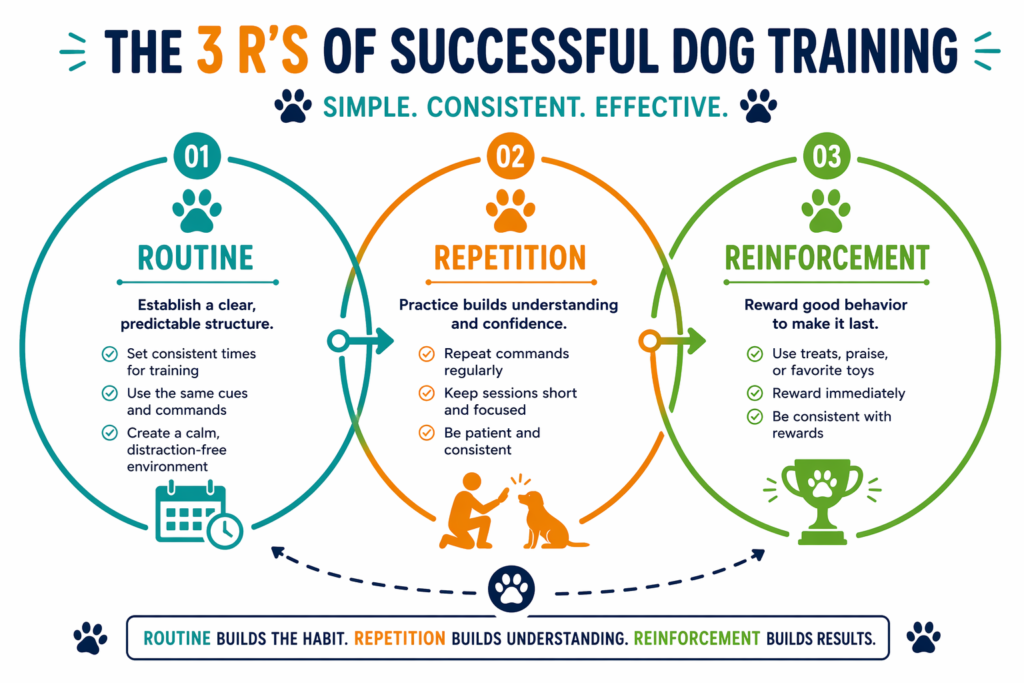
I call this the 3R framework — and it’s the backbone of every successful puppy training plan I’ve ever followed or taught:
- This is your daily schedule. Same wake-up time, same feeding time, same potty windows, same bedtime. Routine creates expectation — and expectation creates calm. Routine:
- Commands only stick through repetition. A puppy hearing ‘sit’ 200 times over two weeks learns it faster than one hearing it 20 times in one session. Spread it out. Repetition:
- Positive reinforcement — meaning treats, praise, and play — is the single most effective training tool for puppies. Punitive methods don’t just fail; they create fear and regression. Reinforcement:
How to combine crate training + potty training + commands
These three things aren’t separate — they work together. The crate creates a structured rest period that also teaches bladder control (because puppies instinctively avoid soiling their sleeping space). That same crate schedule naturally creates potty training windows. And those potty windows? They’re perfect moments to layer in short command training sessions.
The magic formula: crate → potty → reward → 5-minute command session → play → back to crate. Repeat. That loop, done consistently, produces faster results than anything else I’ve tried.
Timing windows that make or break training success
Puppies are most receptive right after waking up and right after eating — their brains are alert and they’re motivated by food. Therefore, always run your training sessions immediately after meals or naps, not before. Training a hungry or sleepy puppy is fighting biology. Work with their natural rhythms instead.
Daily Puppy Training Schedule (Simple Repeatable Routine)
Morning routine (potty, feeding, short training)
The morning sets the tone for the entire day. Here’s what I recommend:
- 6:00–7:00 AM — Take puppy outside immediately upon waking. Use a consistent cue word like ‘go potty.’ Reward with a treat and praise the moment they finish.
- 7:00 AM — Feed breakfast. Use a portion of the kibble as training treats.
- 7:10 AM — 3–5 minute training session (age-appropriate commands).
- 7:20 AM — Supervised play or brief walk.
- 7:40 AM — Crate rest. Most puppies need to nap within 90 minutes of waking.
Midday routine (play, socialization, rest cycles)
If you’re home at midday (or have a dog walker), this window is critical for young puppies:
- 12:00 PM — Potty trip outside.
- 12:10 PM — Lunch feeding.
- 12:20 PM — Short training session — practice commands from the morning.
- 12:30 PM — Socialization time: expose puppy to new sounds, surfaces, or people.
- 1:00 PM — Crate rest until mid-afternoon.
For those who work full-time, hiring a midday dog walker or using a doggy daycare for puppies under 4 months is well worth the investment during this critical window.
Evening routine (calm training, crate, wind-down)
Evenings should be calm — not stimulating. Too much excitement before bedtime leads to a wired puppy who won’t settle in the crate.
- 5:30–6:00 PM — Dinner feeding + potty trip.
- 6:15 PM — Brief, calm training session. Focus on impulse control and ‘stay.’
- 7:00 PM — Gentle play or quiet time. Avoid high-energy games after 7 PM.
- 8:30 PM — Last potty trip of the evening.
- 9:00 PM — Crate time. Use a consistent cue like ‘bedtime’ or ‘kennel up.’
Night routine (sleep training + feeding timing)
Under 12 weeks, most puppies need one overnight potty trip — usually around 2–3 AM. Set an alarm rather than waiting for crying, because responding to crying teaches them that crying gets results.
After 12 weeks, most puppies can make it 6–7 hours overnight. By 4 months, many can sleep through without a trip, though individual variation is normal. For a detailed breakdown on when and how much to feed, check out our best puppy feeding schedule guide.
Puppy Training Schedule by Age (Step-by-Step Progression)
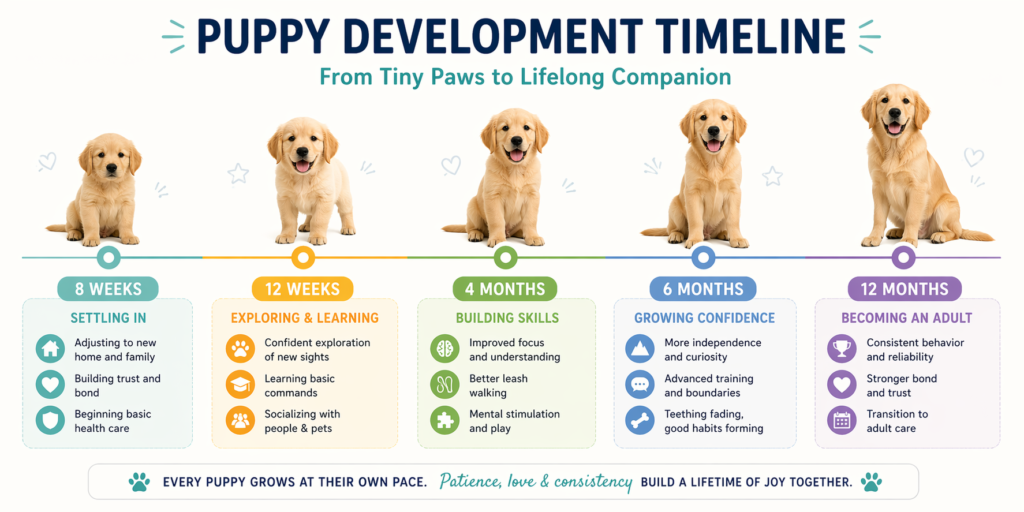
8–10 Weeks: Foundation Stage (Routine + Trust Building)
This is the most important stage — not because of what you teach, but because of the foundation you lay. At 8 weeks, a puppy’s primary need is to feel safe. Pushing too much training at this stage creates anxiety, not learning.
Focus areas for the 8-week-old puppy training schedule:
- Name recognition — say the name, reward eye contact. Simple but crucial.
- Crate introduction — make it positive, never a punishment.
- Potty training — every 45–60 minutes outside during waking hours.
- Sit — just one command. Keep it easy and high-reward.
- Socialization — gentle exposure to new sounds, people, and surfaces.
⚠️ Important: No formal leash walking until fully vaccinated (check with your vet, typically around 16 weeks). Focus on indoor and backyard work first.
10–12 Weeks: Structure Stage (Consistency + Habits)
By 10 weeks, your puppy is starting to map out cause and effect. They’re learning that ‘sit’ leads to a treat, that the crate leads to sleep, and that the door leads to potty time. Your job at this stage is consistency — doing the same thing every time, every day.
Expand on these areas at the 12-week puppy training stage:
- Sit’ and ‘come’ — two commands max.
- Crate duration — start extending to 90-minute rest periods.
- Collar and leash familiarity — let them wear the leash indoors.
- Basic ‘leave it’ — critical for preventing dangerous chewing.
- Bite inhibition — redirect biting onto toys, every single time.
3–4 Months: Learning Stage (Commands + Socialization)
This is the golden window for learning. A 4-month-old puppy has more focus, better bladder control, and a growing capacity for impulse control. This is when training starts to feel like it’s actually working.
For your 4-month-old puppy training schedule, prioritize:
- Sit, stay, come, down, leave it — build the full basic command set.
- Leash walking — introduce structured outdoor walks (post-vaccination).
- Socialization — expose to other dogs, children, traffic, bicycles, different surfaces.
- Crate training — most puppies can now hold it for 3–4 hours.
- Name and recall reliability — practice in low-distraction environments first.
4–6 Months: Discipline Stage (Impulse Control)
Here’s where many owners hit a wall. At 4–5 months, puppies often go through a mini ‘teenage phase’ where previously learned behaviors seem to disappear. In reality, they haven’t forgotten — they’re testing boundaries and being distracted by the world.
The solution is adding distractions gradually. Practice commands in the backyard, then the street, then a park. Raise the bar slowly. Also at this stage:
- Extend ‘stay’ duration and distance — work up to 30 seconds, then 1 minute.
- Introduce ‘place’ command — going to a mat and staying there.
- Reduce treat frequency — begin transitioning to intermittent reinforcement.
- Increase training session length to 7–10 minutes.
6–12 Months: Advanced Stage (Real-World Behavior)
By 6 months, your puppy should have a solid foundation. The next six months are about reliability — making sure behaviors hold up in the real world, not just in the living room.
For a 6-month-old puppy training schedule and beyond, focus on:
- Real-world command reliability — in parks, on streets, around distractions.
- Off-leash recall in a securely fenced area.
- Greeting manners — no jumping on guests.
- Loose-leash walking without constant corrections.
- Advanced stay and down-stay in various environments.
You can also check out our broader guide on how to train a dog at home for techniques that extend naturally into the 6–12 month phase.
Crate Training Schedule That Builds Independence (Not Anxiety)
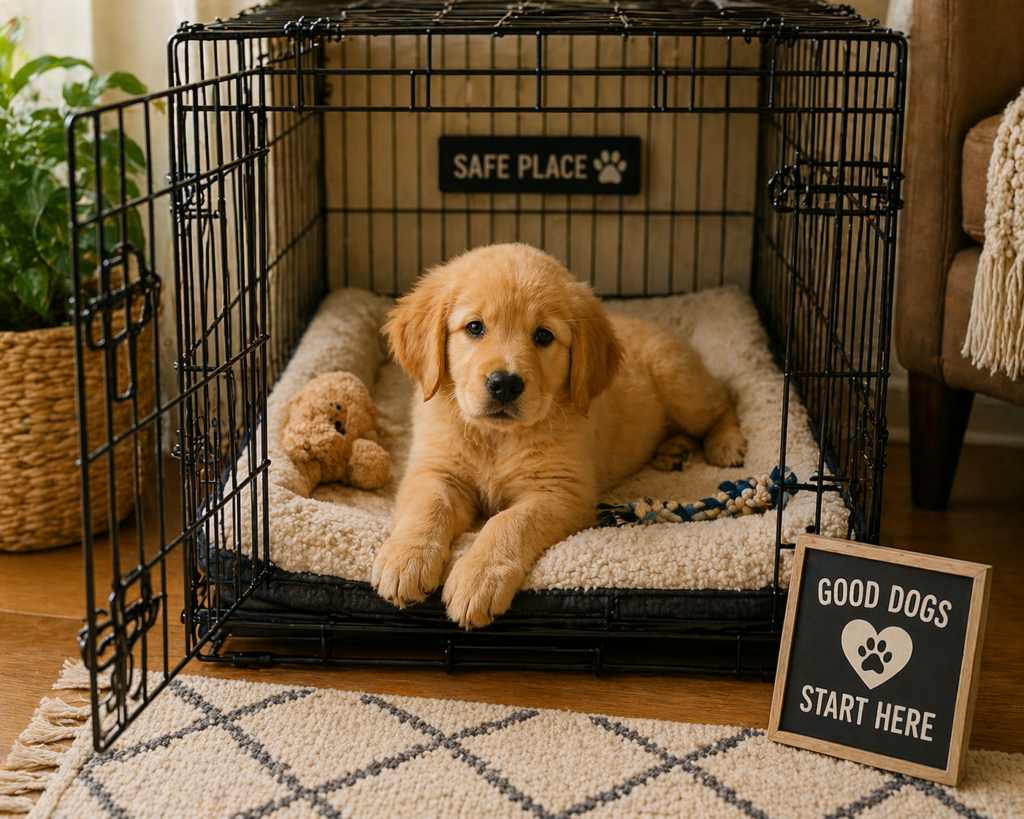
Step-by-step crate training plan by age
Crate training a puppy is not about confinement — it’s about creating a safe den where your dog genuinely wants to go. Done right, most dogs will choose their crate voluntarily by 4 months. Here’s how to get there:
- Week 1 (8–9 weeks): Leave crate door open. Toss treats inside. Feed meals near or inside the crate. No locking yet.
- Week 2 (9–10 weeks): Close the door for 5 minutes while you’re in the room. Reward calmness, not whining.
- Week 3 (10–11 weeks): Extend to 15–20 minutes. Leave the room briefly.
- Week 4 (11–12 weeks): Work up to 45–90 minutes during the day.
- Month 2 (12–16 weeks): Most puppies can stay 2–3 hours comfortably during daytime.
Daily crate training schedule (8 weeks vs 12 weeks)
| Time Slot | 8-Week Puppy | 12-Week Puppy |
| Morning | Open crate intro, 5–10 min | 60–90 min crate rest |
| Mid-morning | Nap in crate (30–45 min) | Nap (90 min) |
| Midday | Out, then short crate rest | Out, then 2-hr crate |
| Afternoon | Out, play, then crate rest | Out, then 2-hr crate |
| Evening | Out for dinner, play, crate | Short crate before bed |
| Night | 4–5 hrs (wake for potty) | 5–6 hrs uninterrupted |
How long a puppy should stay in a crate by age
Here’s the general rule — a puppy can hold their bladder for approximately one hour per month of age, plus one. So a 2-month-old can last about 3 hours maximum during the day (not at night). Use this as your ceiling, not your target.
| Age | Max Daytime Crate Duration |
| 8–10 weeks | 1–2 hours max |
| 10–12 weeks | 2–3 hours max |
| 3–4 months | 3–4 hours max |
| 4–6 months | 4–5 hours max |
| 6 months+ | Up to 6 hours (not ideal long-term) |
Mistakes that cause crate resistance
I’ve seen these mistakes ruin weeks of progress:
- Using the crate as punishment — this destroys the positive association completely.
- Letting the puppy out when they whine — this teaches them whining works.
- Too big a crate — if they can potty in one corner and sleep in another, they will.
- No exercise before crating — a puppy with unspent energy cannot settle.
- Abrupt crating from day one — always build up gradually.
Potty Training Schedule That Actually Works Fast
The hourly potty training framework (by age)
Potty training is almost entirely a scheduling problem. The puppy doesn’t choose to have accidents — they simply can’t hold it when their bladder is full and there’s no signal telling them where to go. Here’s the frequency framework I use:
| Age | Potty Break Frequency (Waking Hours) |
| 8–10 weeks | Every 30–45 minutes |
| 10–12 weeks | Every 45–60 minutes |
| 3–4 months | Every 1.5–2 hours |
| 4–6 months | Every 2–3 hours |
| 6 months+ | Every 3–4 hours |
In addition, always take your puppy out: immediately upon waking, within 10 minutes of eating, after play, and before crating.
For a much deeper dive into potty training techniques, including troubleshooting persistent accidents, visit our comprehensive guide on how to potty train a puppy fast.
Signs your puppy needs to go (timing cues)
Watch for these behavioral signals — they’re your 30-second warning:
- Sniffing the floor in circles
- Squatting or crouching suddenly
- Going to the door or looking around nervously
- Stopping play abruptly
- Whining or pawing
Night potty training strategy
For puppies under 12 weeks, set an alarm for one overnight trip rather than waiting for them to cry. Take them out quietly — no play, no talking, just potty and back to the crate. Keep it boring. The goal is to communicate that nighttime is for sleeping, not socializing. Most puppies eliminate their overnight trip naturally between 12–16 weeks.
Why most potty training schedules fail
In my experience, potty training fails for three reasons. First, owners miss the signals and react after the fact. Second, they don’t go outside often enough in the early weeks. Third — and most commonly — they don’t clean accidents properly. Any trace of scent will draw the puppy back to the same spot. Use an enzymatic cleaner every time, without exception.
Command Training Schedule (When to Teach What)
First commands to teach (sit, name, recall)
Less is more at the beginning. I always start with three things: the puppy’s name, ‘sit,’ and ‘come.’ These aren’t arbitrary — they’re the foundation commands that make every other skill easier to build. Name recognition creates focus. ‘Sit’ teaches that commands lead to rewards. ‘Come’ is the safety command that could save their life one day.
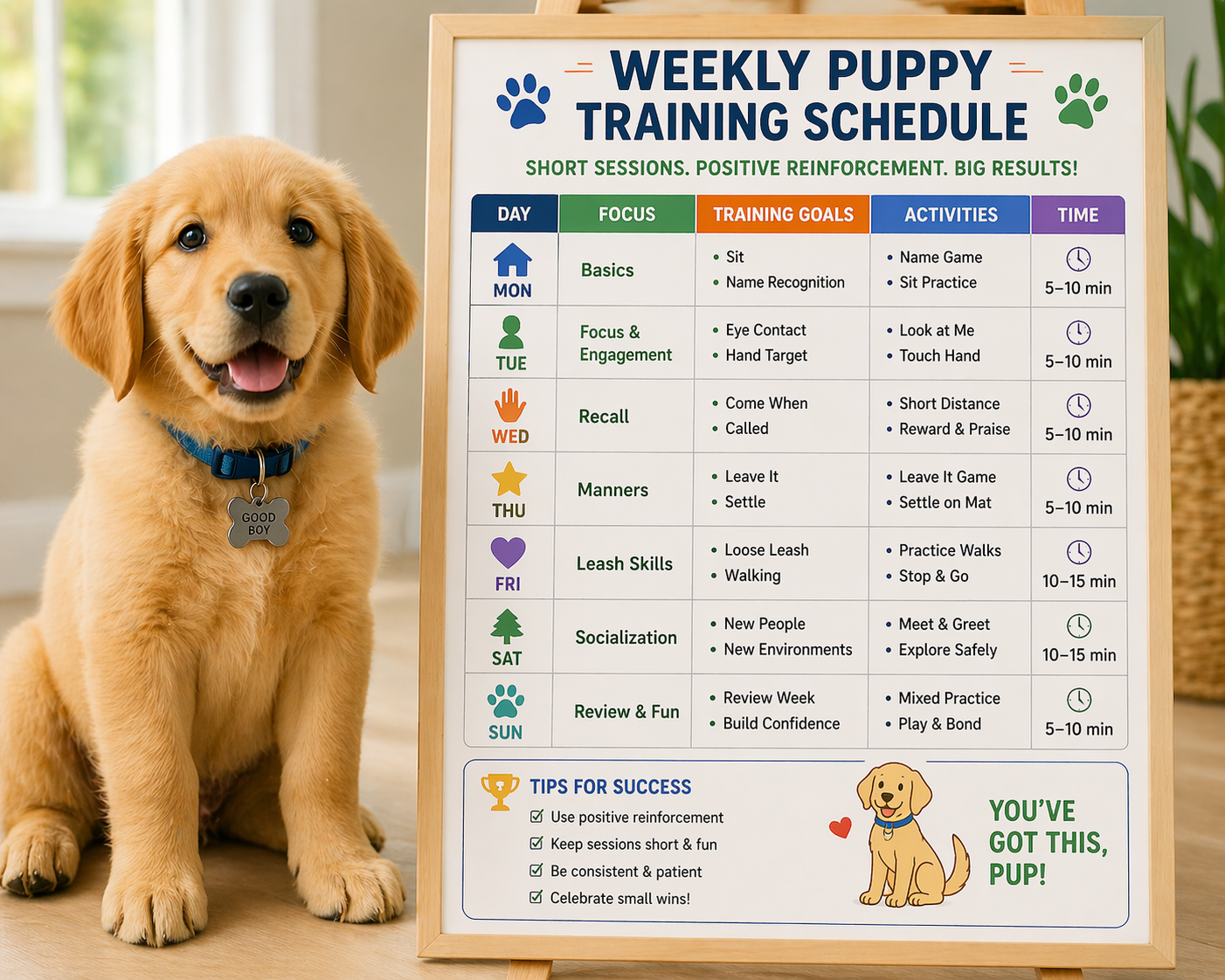
Weekly command progression plan
| Week / Age | Commands to Introduce |
| Weeks 1–2 (8–10 wks) | Name recognition, Sit |
| Weeks 3–4 (10–12 wks) | Come, Leave it |
| Month 2 (3 months) | Down, Stay (2–3 sec) |
| Month 3 (4 months) | Stay (10–30 sec), Place, Off |
| Month 4–5 (5 months) | Heel, Wait, Drop it |
| Month 6+ (6 months) | Distance commands, Off-leash recall |
How to avoid overwhelming your puppy
Here’s a rule I swear by: only introduce one new command per week. Introduce it fresh, practice it often, and proof it in different locations before moving on. Puppies don’t fail at commands — they fail when too many commands are introduced too quickly, causing confusion and mental fatigue.
Reinforcement strategies that work faster
Use high-value treats for new commands and familiar environments. As the command becomes reliable, switch to lower-value treats. Eventually, practice without treats in most sessions — but always carry them for proofing new environments. Variable reinforcement (not rewarding every single time) actually creates stronger behavior once the command is established. Think of it like a slot machine — unpredictable rewards are more motivating than guaranteed ones.
Handling Common Behavior Problems with a Training Schedule
Separation anxiety training routine
Separation anxiety is one of the most misunderstood puppy issues. Most of what owners call ‘separation anxiety’ is actually normal puppy distress — the good news is that a structured schedule prevents most of it from developing into a real problem. The key is teaching independence from day one.
Practice ‘alone time’ in short bursts: leave the room for 30 seconds, return calmly. Extend gradually. Never make departures or arrivals a big emotional event. That means no long goodbyes and no excited greetings. Boring is better. A puppy’s separation anxiety training schedule should include at least 2–3 short alone-time practice sessions every day.
Biting and chewing control schedule
Puppy biting is normal — but it should be redirected immediately and consistently. Every time teeth touch skin, make a calm ‘ow’ sound, withdraw attention, and redirect to an appropriate toy. This works, but only if everyone in the household does it the same way, every time. Inconsistency is what makes biting persist past the expected phase (which usually ends by 4–5 months with consistent training).
Barking and attention-seeking behavior
Puppies bark for attention, out of boredom, or because they’ve learned that barking gets results. The solution is deceptively simple: never reward barking with attention. Not even to say ‘no.’ Instead, wait for silence — even a second of it — and then reward that. Schedule adequate mental stimulation and play into your daily routine to address boredom barking before it starts.
Overexcitement and lack of focus
If your puppy is too wound up to train, the session should not start. I use a simple ‘settle’ routine before every training session — ask the puppy to lie down, wait for calm breathing, then begin. This conditions focus before commands even start. Additionally, training after vigorous exercise (not before) produces calmer, more attentive sessions.
Beginner vs Advanced Puppy Training Approach
What beginners usually do wrong
I’ve watched new dog owners make the same mistakes over and over, and none of them are uninformed— they’re just not obvious until you’ve done this a few times:
- Training in long, infrequent sessions instead of short, frequent ones
- Using the puppy’s name as a correction (‘No, Max!’ teaches the name = bad news)
- Repeating commands — if they don’t respond to ‘sit’ once, repeating it teaches them to ignore it
- Rewarding the wrong thing — petting a puppy who’s jumping on you rewards the jumping
- No written schedule — keeping it in your head leads to inconsistency
What experienced dog owners do differently
Experienced owners train with less effort because they’ve built systems. They use the environment to their advantage — feeding from a puzzle feeder counts as mental training, for example. They also know when to stop: the moment a puppy loses focus, the session ends. And they proof every command in three different locations before considering it reliable.
When to level up training intensity
A good rule of thumb: when your puppy can perform a command correctly 8 out of 10 times in a familiar environment, it’s time to proof it in a new location. When they can do it in 3 different environments, it’s time to add distractions. When they nail it with distractions, reduce the treat frequency. That’s the progression.
Breed-Specific Adjustments to Your Training Schedule
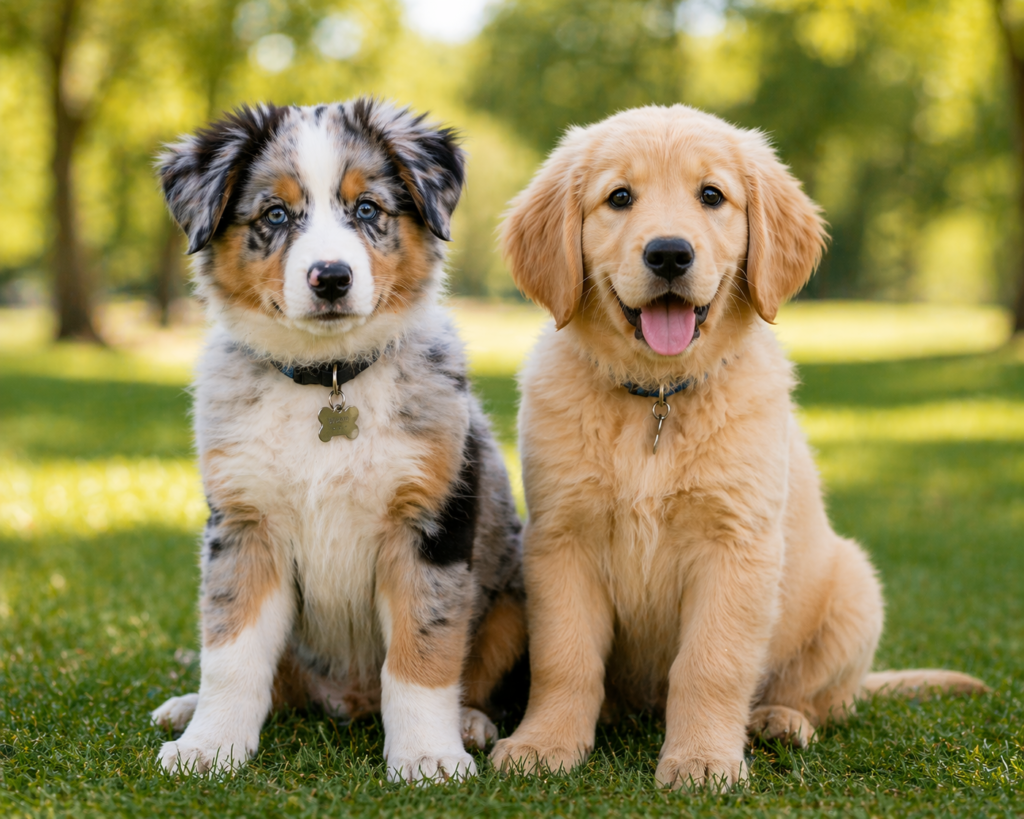
High-energy breeds (e.g., Australian Shepherd, GSP)
If you’re working with an Australian Shepherd puppy training schedule or a GSP (German Shorthaired Pointer), be ready to double the physical and mental exercise. These breeds are not content with two 5-minute sessions a day. They need:
- Physical exercise before training sessions (a tired dog focuses better)
- Mental enrichment built into every slot — puzzle feeders, scent games, tracking exercises
- Longer daily training blocks (by 4 months, up to 15 minutes per session is appropriate)
- A job or sport to channel their drive — agility, nose work, or herding games
Family-friendly breeds (e.g., Labrador, Golden Retriever)
For a Labrador puppy training schedule or a Golden Retriever puppy training schedule, training is generally smoother — these breeds are highly food-motivated and eager to please. However, that same eagerness can cause distraction, especially around people. Additionally, both breeds mature slowly and can remain puppy-brained until 2–3 years old, so don’t expect adult-level reliability at 12 months.
Looking for a family-friendly breed? Browse our top 20 best family dog breedsto find a dog that matches your household’s energy level.
How breed traits change training frequency
Generally: working breeds (Aussies, Borders, GSPs) need 2–3x the daily engagement of companion breeds. Brachycephalic breeds (Bulldogs, Pugs) tire quickly and need shorter sessions. Scent hounds (Beagles, Basset Hounds) follow their nose — training outdoors is harder until recall is rock solid. Toy breeds are smart but tire mentally faster. Adjust your schedule accordingly.
Tools & Resources That Make Training Easier
Must-have tools (crate, leash, treats, timers)
You don’t need a lot of equipment to train a puppy well. Here’s what I actually use and recommend:
- Appropriately sized (puppy can stand, turn, lie down — but not roam). Wire crates with dividers let you size up as they grow.Crate:
- Standard leash for training. Avoid retractable leads — they teach dogs to pull.6-foot leash:
- Small, soft, and smelly. Training treats should be pea-sized, not full-size biscuits.High-value treats:
- Powerful for marking exact behaviors. However, consistent verbal markers (‘yes!’) work just as well.Clicker (optional):
- Use it to keep sessions to the correct length. You’ll be surprised how often you’d run over.Kitchen timer or phone timer:
- Non-negotiable for potty accidents. Regular cleaners don’t remove the scent markers.Enzymatic cleaner:
For a complete checklist of everything you need before your puppy arrives, our puppy essentials checklist covers all the bases.
Printable puppy training schedule templates
A printable schedule posted on the fridge is one of the most underrated training tools there is — especially in multi-person households where everyone needs to be on the same page. Your template should include: feeding times, potty windows, training session slots, crate time, play windows, and bedtime. Keep it simple enough that a visiting family member could follow it.
Best free puppy training guides and PDFs
Beyond this guide, some resources I’ve found genuinely helpful include the AKC’s puppy training resources, the ASPCA’s behavior team articles, and certified trainer blogs like Kikopup on YouTube. These align with modern, science-based positive reinforcement methods — which is what the research consistently shows works best.
Common Mistakes That Kill Puppy Training Results
Inconsistent schedules
This is the number one training killer. A puppy who eats at different times every day, is crated randomly, and gets walked whenever you feel like it cannot form the internal rhythm that makes training fast. Inconsistency looks like: potty accidents despite ‘trying,’ a puppy that won’t settle in the crate, and commands that never seem to stick. Therefore, treat your schedule like a non-negotiable appointment for the first 8–12 weeks.
Training sessions that are too long
I’ve watched puppies go from engaged to completely checked out in under 3 minutes. When a puppy starts sniffing the floor, looking away, yawning, or lying down during a session — it’s over. Continuing past that point doesn’t build patience; it builds negative associations with training. End on a success, even if it means going back to a command you already know they know.
Ignoring rest and sleep cycles
Puppies under 4 months need 16–18 hours of sleep per day. That’s not an exaggeration. Sleep deprivation in puppies causes irritability, biting, inability to focus, and emotional dysregulation — all of which owners often misread as behavior problems. If your puppy is acting out, check their sleep first. The answer is usually more crate time and fewer outings, not more training.
Reinforcing bad behavior accidentally
Every interaction is training. When you let your puppy jump up because it’s cute right now, you’re training a behavior that will be frustrating at 60 pounds, you pick up a whining puppy, you’re training them to whine for pickup. When you repeat ‘come, come, come, COME’ — you’re training them to wait for the fourth repetition. Be intentional with every response.
Puppy Training Checklist (Daily + Weekly)
Daily checklist for structure and consistency
Post this on your fridge or photograph it for your phone:
- ☐ Morning potty trip within 60 seconds of waking
- ☐ Breakfast at consistent time
- ☐ 3–5 min training session (age-appropriate)
- ☐ Supervised play period
- ☐ Crate nap with appropriate duration
- ☐ Midday potty + feeding (under 3 months)
- ☐ Afternoon training session or mental enrichment
- ☐ Evening meal + potty
- ☐ Calm evening routine — no high energy after 7 PM
- ☐ Bedtime crate + last potty trip
Weekly progress checklist
Run through this every Sunday:
- ☐ Is my puppy reliably sitting on the first cue 8/10 times?
- ☐ Are potty accidents decreasing week over week?
- ☐ Is crate whining reducing or gone?
- ☐ Have I introduced the next command in the progression?
- ☐ Have I proofed existing commands in a new location?
- ☐ Am I maintaining consistent schedule times?
Signs your training is working
It’s easy to doubt yourself in the early weeks. However, these are the signs that tell me a puppy’s training is actually on track:
- Fewer unprompted accidents — down to 0–1 per day by week 3–4 of consistent training
- Puppy goes to the crate voluntarily at rest times
- First-cue response to ‘sit’ in familiar environments
- Puppy checks in with eye contact during walks
- Biting and mouthing is reducing in frequency and pressure
- Puppy settles within 5 minutes in the crate at night
FAQ: Common Puppy Training Questions
What is the 10-10-10 rule for puppies?
The 10-10-10 rule is a socialization framework that recommends exposing your puppy to 10 different people, 10 different places, and 10 different experiences by the time they’re 10 weeks old. The idea is to maximize the critical socialization window (roughly 3–12 weeks) to build a confident, adaptable dog. In practice, I recommend continuing this level of socialization well beyond 10 weeks — the window doesn’t slam shut, it just gradually narrows.
What is the 7-7-7 rule for puppies?
The 7-7-7 rule is a socialization checklist for puppies by 7 weeks of age (before they typically leave the litter): 7 different surfaces walked on, 7 different locations visited, 7 different people met, 7 different challenges navigated, and so on. It’s a breeder-side guideline, but as a new owner, adopting the spirit of this rule and continuing systematic socialization through week 16 will produce a significantly more well-adjusted adult dog.
What is a good training schedule for a puppy?
A good puppy training schedule is built on four pillars: a consistent daily routine (same times every day), short and frequent training sessions (2–5 minutes, 3–5 times daily for young puppies), age-appropriate commands (don’t rush the progression), and structured rest (more sleep than you think they need). The schedule in this guide is what I recommend — it adapts as your puppy grows and keeps training sustainable for both of you.
Can a puppy go 12 hours without food at night?
Yes — once a puppy is around 3–4 months old, they can typically go 8–10 hours overnight without food, and many manage 12 hours without issues. However, in the first 8–12 weeks, puppies generally need 3 meals per day and cannot go that long. More importantly, ‘no food’ doesn’t mean ‘no potty trip’ — young puppies still need overnight bathroom breaks even if their last meal was hours ago. If you’re unsure about your puppy’s specific feeding needs, our puppy feeding schedule guide has the full breakdown by age.
Final Action Plan: Build Your Puppy Training Schedule Today
Step-by-step plan to create your schedule
Here’s how to build your personalized schedule right now — no overthinking required:
- Write down your fixed daily times: when you wake up, when you leave for work, when you return, when you go to bed.
- Build your puppy’s schedule around those anchors: feeding, potty, crate, and training windows.
- Identify who in your household is responsible for each slot (especially important in multi-person homes).
- Post the schedule somewhere visible. A printed version on the fridge works better than a note on your phone.
- Set phone alarms for potty windows for the first two weeks — until the routine becomes automatic.
How to stay consistent even with a busy routine
Consistency doesn’t mean perfection. Missing a session occasionally is fine — what matters is that 90% of your days follow the same pattern. However, the big wins come from two things: same feeding time every day (this drives the potty schedule), and a crate every time the puppy needs to rest (not just sometimes). Those two habits, done consistently, do most of the heavy lifting. For dog owners managing a full schedule, check out our guide to low-maintenance dog breeds for busy people— and also our article onhow to take care of a puppy for beginners.
What to track in the first 30 days
Keep a simple log for the first 30 days. Track: potty accidents (date, time, location), training sessions (what was practiced, response rate), crate behavior (any whining? duration), and sleep (is the puppy settling at night?). This data tells you whether the schedule is working or needs adjustment — and it’s far more useful than gut feeling.
When to adjust your puppy training schedule
Adjust when: your puppy is consistently having accidents (take out more often), they’re consistently ignoring commands in sessions (sessions are too long or too frequent), or they’re showing crate resistance after previously being calm (something changed — check exercise levels, crate duration, or health). Also adjust naturally at each age milestone — don’t keep a 6-month-old on an 8-week schedule. The schedule should evolve with your dog.
Conclusion
Here’s the bottom line: a puppy training schedule isn’t about controlling your dog — it’s about giving them the structure they need to thrive. Puppies don’t come pre-programmed. They rely on you to create the predictability, consistency, and guidance that lets their brain develop properly.
In my experience, the owners who struggle with their dogs are rarely dealing with ‘problem dogs.’ They’re dealing with dogs who never had a consistent schedule. And the owners who seem to have it all figured out? They’ve simply followed a structured plan and stuck to it, even on the hard days.
Use this guide as your reference point. Come back to it as your puppy grows. Adjust the schedule at each age milestone. Stay consistent, keep sessions short, reinforce what you want more of — and I promise, the results will follow.
🐾 Ready to get started? Save this page, print the checklists, and build your personalized puppy training schedule today. Your future self — and your dog — will thank you.