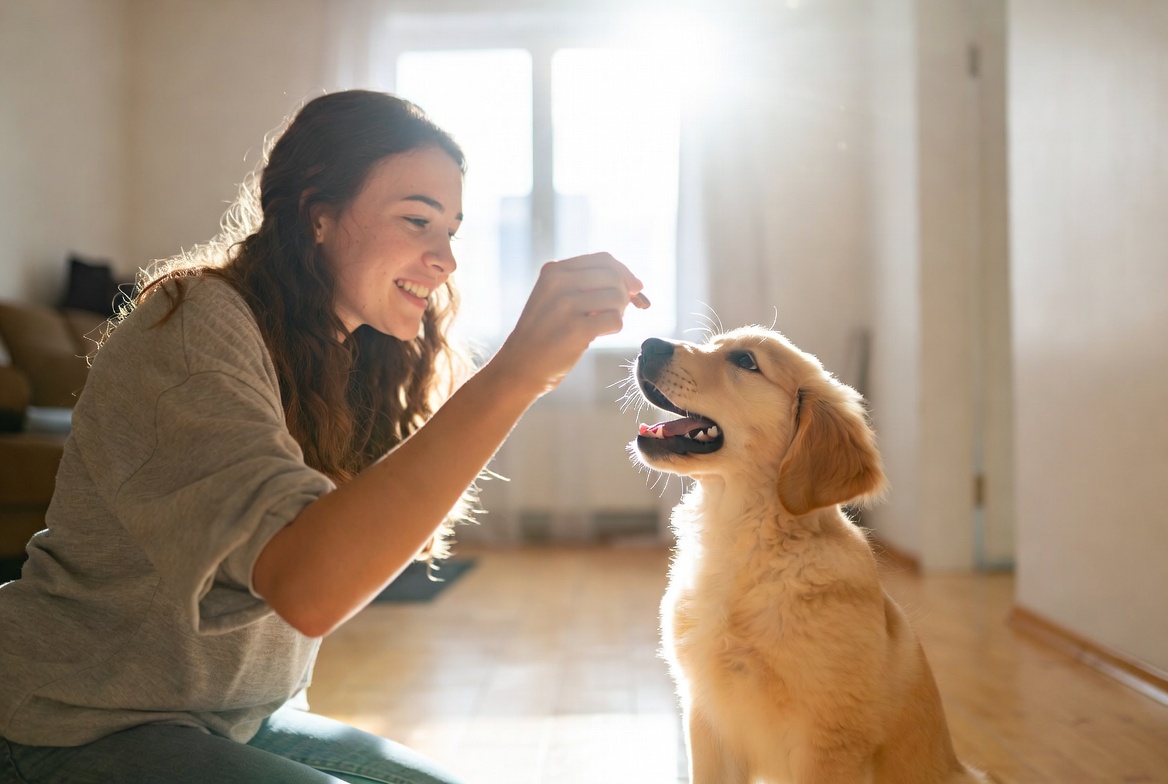
Knowing how to train a dog at home is one of the most valuable skills you can develop as a new pet owner. You do not need expensive group classes or a professional trainer to get started. In fact, most dogs respond better when training happens in the environment they already feel safe in — your living room, your backyard, your kitchen.
This guide is built for beginners. Whether you just brought home a puppy, adopted a rescue dog, or simply want to improve your dog’s behavior without breaking the bank, you will find everything you need here. We cover the most important commands, a realistic 14-day training schedule, common mistakes to avoid, and practical exercises you can start today.
Most beginners start seeing real improvement within two to three weeks of consistent daily practice. Some commands click in just a few days. The key is not how long you train — it is how consistently you show up.
Let’s get started.
Quick Answer: The Best Way to Train a Dog at Home
Short on time? Here is the condensed version of what actually works:
- Use short daily sessions — five to ten minutes is enough for most dogs
- Start with the simplest commands first, like Sit and Come
- Reward your dog immediately — within one to two seconds of the correct behavior
- Use the same word every single time for every command
- Focus on one skill at a time before introducing a new one
- Keep sessions positive and always end on a small win
- Most dogs start responding consistently within one to three weeks
✅ Quick Tip: Five minutes of focused training every day beats one long session on the weekend. Repetition and consistency are everything.
Why Home Dog Training Works Better Than Most People Think
A lot of first-time dog owners assume they need to enroll in a class or hire a trainer before they can make real progress. That is simply not true. Home training has unique advantages that group classes cannot offer.
Dogs Learn Best in Familiar Environments
When your dog is at home, they are calm, comfortable, and not competing for attention. A group class environment — with other dogs, unfamiliar people, and loud noises — can be genuinely stressful for many dogs, especially puppies and rescues. A stressed dog does not learn well. Training at home removes that variable entirely.
Consistency Matters More Than Equipment
You do not need a professional-grade clicker, a special harness, or premium treats to train your dog. What matters most is using the same words, the same tone, and the same routine every single day. Expensive tools are no substitute for a calm, consistent owner.
Home Training vs. Group Classes
Group classes are great for socialization and advanced obedience. But for teaching basic commands to a new dog, home training is often more effective. You control the distractions, the pace, and the reward timing in ways that a class environment simply does not allow.
When Professional Help May Still Be Needed
Home training works extremely well for most dogs and most behaviors. However, if your dog shows aggression, severe anxiety, or resource guarding, professional guidance becomes important. We cover this in detail later in the guide.
Who This Dog Training Guide Is For
This guide is designed to be practical and approachable for a wide range of dog owners. Here is who will benefit most.
Best for First-Time Dog Owners
If you have never trained a dog before, this guide walks you through everything step by step. No experience is required. We explain not just what to do, but why it works — so you can adapt when your dog surprises you.
Best for Puppy Training
Puppies have short attention spans but learn remarkably fast. The earlier you start, the better. Puppies as young as eight weeks old can begin learning basic commands. Short sessions of three to five minutes work best at this age.
Best for Rescue Dogs or Older Dogs
The old saying that you cannot teach an old dog new tricks is a myth. Older and rescue dogs can absolutely learn new behaviors — they may just take a little longer to unlearn old habits. Patience and positive reinforcement are especially important with rescues who may have had difficult pasts.
Best for Busy Families With Limited Time
You do not need hours every day. Even two or three five-minute sessions spread throughout the day are enough to build solid skills over time. This guide includes a realistic daily routine built around busy schedules.
What You Need Before You Start Training Your Dog
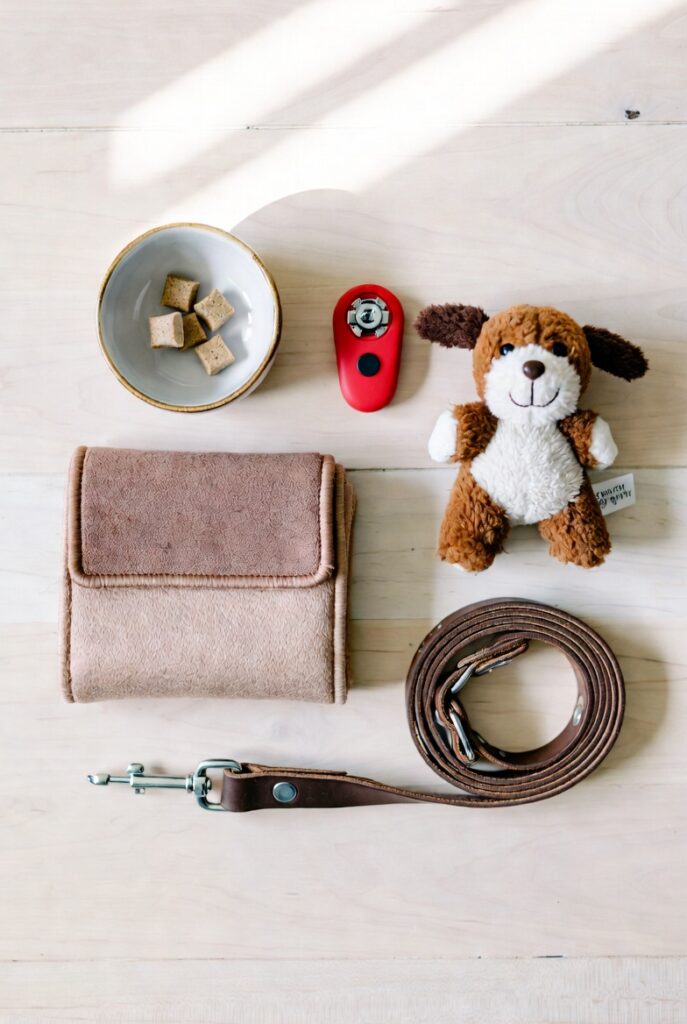
Before your first training session, gather a few basics. You do not need much — but having the right setup makes a noticeable difference from day one.
Basic Supplies for Dog Training at Home
- Treats — small, soft, smelly treats work best. Think pea-sized pieces of chicken, cheese, or commercial training treats.
- Leash — a standard four to six foot leash is ideal for most indoor and outdoor sessions.
- Clicker (optional) — a clicker marks the exact moment your dog does something right. Not mandatory, but very helpful.
- Crate — useful for potty training and teaching your dog to settle independently.
- Toys — some dogs are toy-motivated rather than treat-motivated. Know what your dog finds rewarding.
- Training mat or small rug — gives your dog a designated target spot for certain exercises.
Setting Up a Distraction-Free Training Space
Start training in a quiet room with no other pets, minimal foot traffic, and the TV off. Once your dog knows a command reliably in that low-distraction space, gradually introduce more noise and movement. Jumping straight to outdoor training before your dog understands a command indoors is one of the most common beginner mistakes.
Choosing Rewards That Actually Motivate Your Dog
Not every dog is equally treat-motivated. Some go wild for food but barely glance at a toy. Others could not care less about food but will do anything for a game of tug. Figure out what your dog finds most rewarding — that is your most powerful training tool. High-value treats like small pieces of chicken or cheese are ideal for teaching new behaviors. Lower-value treats like dry kibble work fine once the behavior is already established.
How Long Training Sessions Should Be
Keep sessions between five and ten minutes for most adult dogs. For puppies under four months old, three to five minutes is plenty. End the session while your dog is still engaged — not when they start losing focus. The goal is always to finish on a success.
The 7-Step Beginner Dog Training Framework
Before diving into specific commands, it helps to understand the overall process. These seven steps form the foundation of all successful home dog training.
Step 1: Build Trust Before Teaching Commands
Spend the first day or two simply being calm and present with your dog. Let them sniff you, explore the space, and get comfortable. Hand-feed meals or offer small treats without asking for anything in return. Trust is the foundation that every command is built on. A dog that does not trust you will not reliably respond to you, no matter how many times you repeat a cue.
Step 2: Choose One Command at a Time
This is where many beginners go wrong. They try to teach Sit, Stay, Come, and Down all in the same week and wonder why their dog is confused. Pick one command. Work on it until your dog responds reliably eight or nine times out of ten. Only then do you add a second command.
Step 3: Use the Same Words Every Time
Dogs respond to the sound of a word, not its meaning. If you say “sit” one day, “sit down” the next, and “hey, sit!” the day after that, your dog hears three different commands. Choose one word per behavior and stick with it. Make sure everyone in the household uses the same word.
Step 4: Reward Immediately
Timing is critical. You have approximately one to two seconds after your dog performs the correct behavior to deliver a reward. Any longer and your dog starts associating the reward with whatever they did after the behavior — not the behavior itself. This is where a clicker is genuinely useful. It bridges the gap between the behavior and the treat.
Step 5: Repeat in Short Sessions
Repetition is how dogs learn, but only in small doses. Aim for five to fifteen repetitions per session. Do two to three sessions spread across the day rather than cramming everything into one long stretch. Mental fatigue is real.
Step 6: Add Mild Distractions Slowly
Once your dog knows a command reliably in a quiet room, start adding small distractions. Have someone walk past. Try practicing in a different room. Open a window so outside sounds drift in. Slowly increasing the level of distraction teaches your dog that the command applies everywhere, not just in your quiet kitchen.
Step 7: Practice in Different Rooms and Outdoors
Dogs do not automatically generalize commands. A dog that knows “sit” perfectly in the living room may act like they have never heard the word in the backyard. Practice every command in at least three different locations before assuming it is solid. This process is called proofing.
✅ Expert Insight: Trainer Zak George often points out that the best sessions end before the dog gets bored. Leaving your dog wanting more is one of the most underrated training strategies available to any owner.
The First 10 Dog Commands Every Beginner Should Teach
Below is the full beginner command list, in the order most trainers recommend teaching them. Each entry includes why the command matters, how to teach it step by step, the most common mistake beginners make, and how long it typically takes.
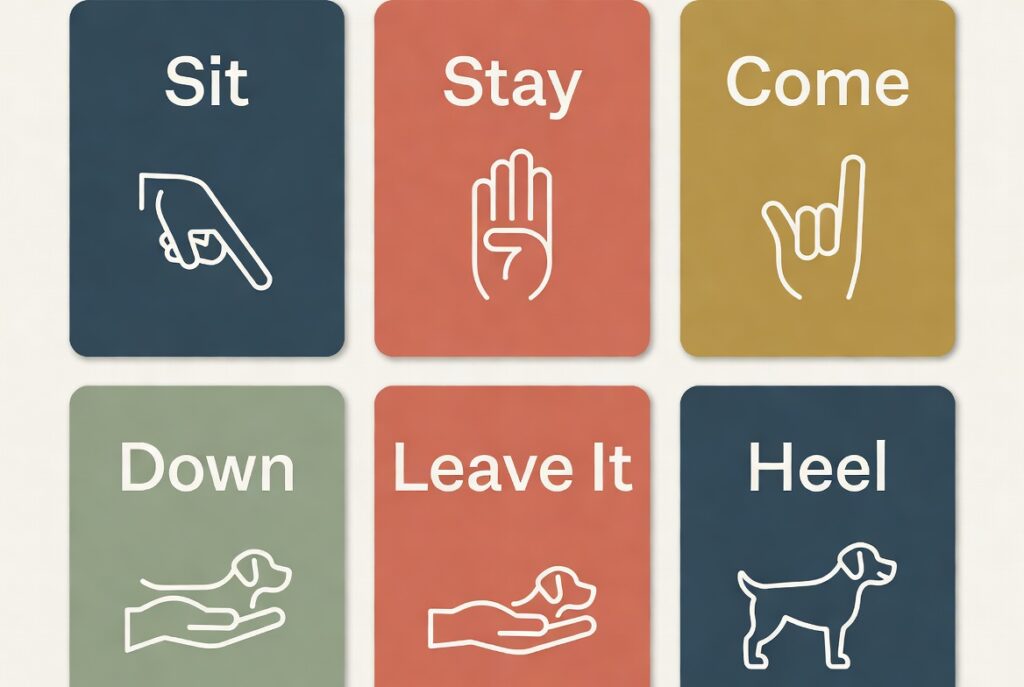
| Command | Difficulty | Why It Matters | Avg. Learning Time |
| Sit | Easy | Foundation for all other commands | 1–3 days |
| Stay | Medium | Builds patience and impulse control | 3–7 days |
| Come | Medium | Critical recall for safety | 1–2 weeks |
| Down | Medium | Calms excited dogs | 3–7 days |
| Leave It | Medium | Prevents dangerous chewing or eating | 3–5 days |
| Heel | Hard | Controls leash pulling | 2–4 weeks |
| Drop It | Medium | Retrieves objects safely from the mouth | 3–5 days |
| Off | Easy | Stops jumping on people | 1–2 weeks |
| Wait | Medium | Prevents door dashing | 1–2 weeks |
| Place | Medium | Teaches dog to go to a designated spot | 1–2 weeks |
Sit
Why it matters: Sit is the gateway command. Once your dog understands that their behavior affects whether they get a reward, every other command becomes easier to teach.
How to teach it: Hold a treat close to your dog’s nose, then slowly move your hand upward. Their bottom will naturally lower as their nose follows the treat. The moment their bottom hits the floor, say “sit” clearly and reward immediately. Repeat five to ten times per session.
Common mistake: Pushing your dog’s bottom down. This teaches them to tolerate being pushed, not to sit on cue. Let the treat lure do the work naturally.
Stay
Why it matters: Stay teaches impulse control. A dog that can hold a position is a safe dog — especially near roads, open doors, and other animals.
How to teach it: Ask your dog to sit. Open your palm toward them like a stop signal and say “stay.” Wait two seconds, then reward. Gradually increase the duration before rewarding. Only increase distance after your dog reliably holds the stay for several seconds.
Common mistake: Increasing duration and distance at the same time. Increase only one variable at a time or you will lose the behavior entirely.
Come
Why it matters: Recall is a genuine safety command. A reliable “come” can prevent your dog from running into traffic or getting into a fight with another dog.
How to teach it: Squat down, open your arms, say “come” in a happy, excited tone, and celebrate enthusiastically when your dog reaches you. Never call your dog to you for something they dislike — like a bath or nail trim — or they will learn to avoid the cue.
Common mistake: Calling your dog to come and then punishing them or ending their playtime. This poisons the recall and makes dogs increasingly reluctant to return when called.
Down
Why it matters: Down is a calming command. It helps settle excited dogs and serves as the foundation for more advanced calm behaviors like Place.
How to teach it: Ask your dog to sit. Hold a treat in a closed fist at their nose, then slowly move it straight down to the floor between their front paws. As their elbows touch the floor, say “down” and reward immediately. Some dogs take a few sessions to feel comfortable in this more vulnerable position.
Common mistake: Repeating “down, down, down” when the dog does not comply immediately. Say it once, wait, lure if needed, reward. Repeated commands train your dog to ignore the first cue.
Leave It
Why it matters: This command can prevent your dog from eating something dangerous — dropped medication, a dead animal outside, or a piece of food that fell on the floor.
How to teach it: Place a treat in each hand. Close one fist and let your dog sniff and paw at it. The moment they stop trying and pull their nose away, say “leave it” and give them the treat from your other hand. Gradually move to treats on the floor covered by your hand, then eventually uncovered.
Common mistake: Rewarding with the very treat you told them to leave. Always reward from a different hand or pocket to keep the lesson clear.
Heel
Why it matters: A dog that pulls on the leash is exhausting and potentially dangerous. Heel teaches your dog to walk calmly at your side.
How to teach it: Start indoors. Hold a treat at your left hip. Say “heel” and begin walking. Reward your dog every few steps for staying at your side. If they pull ahead, stop walking entirely. Movement only continues when the leash is loose.
Common mistake: Allowing pulling sometimes and correcting it other times. Consistency is everything with leash manners. Every single time the leash goes taut, stop.
Drop It
Why it matters: Dogs will inevitably pick up something they should not have. Drop It gives you a safe, positive way to get it back without triggering a chase.
How to teach it: Let your dog hold a toy, then offer a high-value treat near their nose. The moment they drop the toy to take the treat, say “drop it” and reward. Never chase your dog to retrieve an object — it turns into a game they will win every time.
Common mistake: Trading unfairly and never returning the object. If you always take the item and never give it back, your dog learns that Drop It means the fun is permanently over — and they stop complying.
Off
Why it matters: Jumping on people is one of the most common behavior complaints from dog owners. Off teaches your dog that four paws on the floor earns attention.
How to teach it: When your dog jumps, turn your back completely and give zero attention. The moment all four paws are on the floor, immediately turn around and reward with praise or a treat. Ask everyone in the household to do exactly the same.
Common mistake: Giving any attention to jumping — even pushing the dog away counts as interaction and can reinforce the behavior over time.
Wait
Why it matters: Wait tells your dog to pause briefly — at a doorway, before being released from the car, or before their dinner bowl goes down. It is a daily safety habit that becomes second nature.
How to teach it: At a closed door, ask your dog to sit. Begin to open the door. If they rush forward, close it immediately. Reward only when they hold their position. Build up to opening the door fully before releasing them with a release word like “okay” or “free.”
Common mistake: Confusing Wait with Stay. Wait means “pause until I release you from here.” Stay means “hold this position until I come back to you.” They are different skills.
Place
Why it matters: Place teaches your dog to go to a specific spot — a mat, bed, or crate — and stay there calmly. This is incredibly useful during meals, when guests arrive, or when you simply need your dog out from underfoot.
How to teach it: Lure your dog onto a mat with a treat. Say “place” as all four feet touch the mat. Reward generously for staying on it. Gradually increase how long they stay before releasing them. Eventually you can send them to their place from across the room with just a hand signal.
Common mistake: Using Place as a punishment or sending your dog there when you are frustrated. Their mat should always be a positive, safe space — never a penalty.
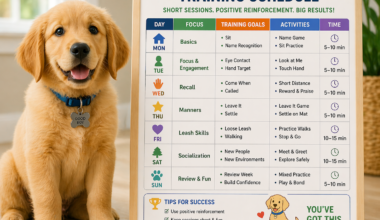
A Simple 14-Day Dog Training Schedule for Beginners
This schedule gives you a clear, realistic plan for your first two weeks. Each block has a specific focus, and the daily routine works even for households with very limited free time.
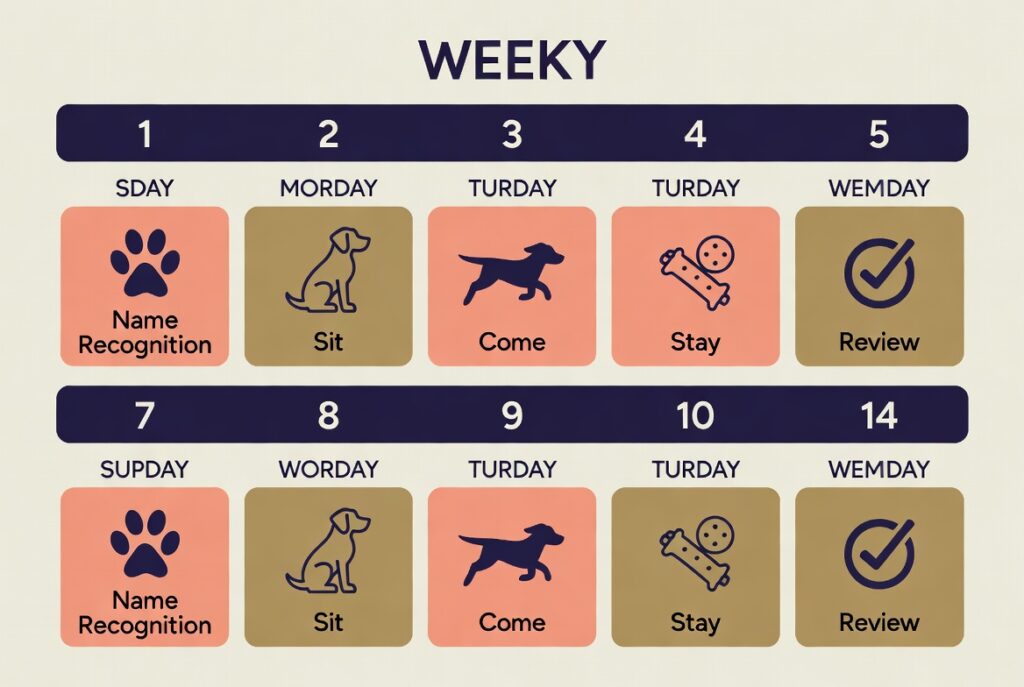
Days 1–3: Trust and Name Recognition
Spend these days building a bond. Hand-feed meals. Call your dog’s name in a happy voice and reward them every time they look at you. No formal commands yet — just positive associations with their name and with you.
Days 4–6: Sit and Stay
Introduce Sit on day four. By day six, add a brief two-second Stay. Keep sessions short and heavily rewarded. You are not aiming for perfection — you are building the pattern of listening and responding.
Days 7–9: Come and Down
Add Come and Down. Practice recall in short distances indoors first. Introduce Down slowly — it is a more vulnerable position for some dogs and may take a few sessions to become comfortable.
Days 10–12: Leave It and Wait
These two commands involve more impulse control and take slightly longer to click. Practice Leave It with your closed fist, then progress to treats on the floor. Introduce Wait at doorways throughout the day.
Days 13–14: Combining Commands
Start chaining commands together. Ask your dog to sit, then stay, then come. Ask for down on their place mat. Short, positive sequences build confidence and reinforce all the individual skills at once.
| Day | Training Focus | Session Length |
| Day 1 | Name recognition + hand-feeding | 3–5 min |
| Day 2 | Name recognition + calm bonding time | 5 min |
| Day 3 | Name + intro to Sit lure | 5 min |
| Day 4 | Sit — 10 repetitions | 5–7 min |
| Day 5 | Sit with hand signal + verbal cue | 5–7 min |
| Day 6 | Sit + intro to Stay (2–3 seconds) | 7 min |
| Day 7 | Stay duration + intro to Come | 7 min |
| Day 8 | Come — short distance indoors | 7 min |
| Day 9 | Come + intro to Down | 7–10 min |
| Day 10 | Down + Leave It (closed fist) | 7–10 min |
| Day 11 | Leave It (treat on floor) | 7–10 min |
| Day 12 | Wait at doorways | 7–10 min |
| Day 13 | Combining: Sit → Stay → Come | 10 min |
| Day 14 | Full sequence + Place mat intro | 10 min |
Sample Daily Routine for Busy Owners
Morning (5 minutes): After your dog’s breakfast, run three to five repetitions of the current command focus. Training after eating works with natural energy levels.
Afternoon (5 minutes): Quick recall practice in the backyard or a different room. Use this session to slowly add a mild distraction.
Evening (5 minutes): End-of-day review. Practice the current command and one previously learned command. Always end with a success, no matter how small.
📋 5-Minute Routine for Extremely Busy Owners: Morning: 5 sit-stays while your coffee brews. Afternoon: 5 recalls in the hallway. Evening: 5 down commands before their dinner bowl goes down. Total: 15 minutes daily. It is enough to make real progress.
Dog Training Exercises You Can Practice at Home
Commands alone are not enough. These exercises build on what you are teaching and develop real-world skills your dog will use every day.
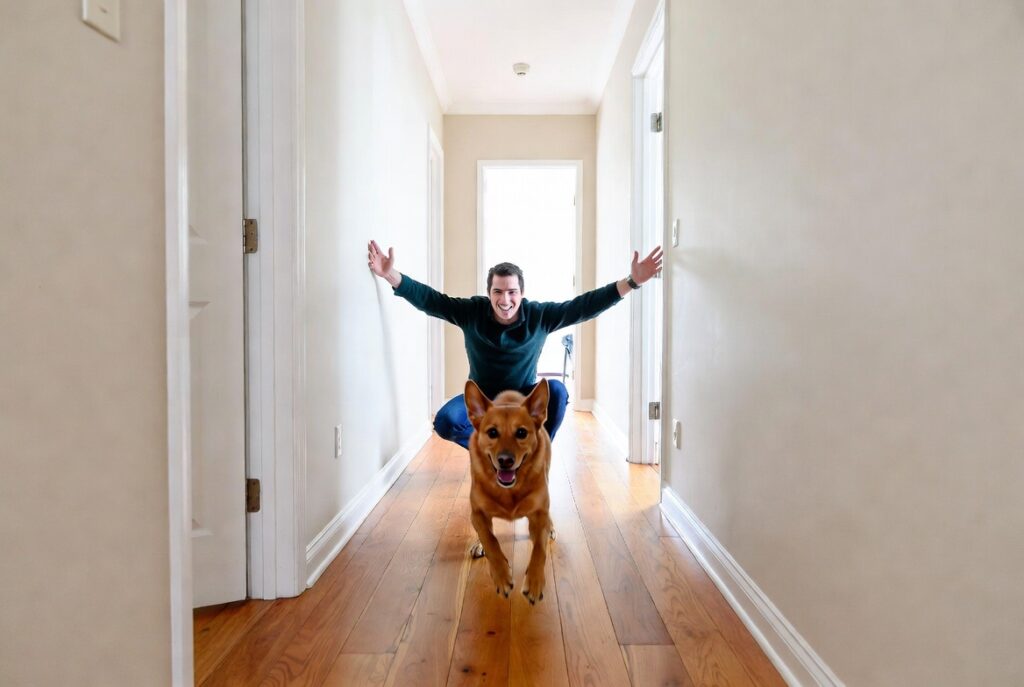
Recall Practice
Play the “ping pong” game. Have two people stand on opposite ends of a room. Take turns calling the dog and rewarding them with treats and enthusiastic praise every time they arrive. This makes recall fast, reliable, and genuinely exciting for your dog.
Leash Walking Indoors
Before tackling the sidewalk, practice walking calmly on leash inside the house. Walk a loop through your living room, rewarding your dog for staying at your side. This builds the muscle memory for loose-leash walking without the distractions of the outdoors.
Door Manners
Practice waiting at every door you open throughout the day — front door, back door, car door. Ask for a Sit or Wait before the door opens. This becomes a strong daily habit very quickly because it happens so many times naturally.
Crate Training Exercises
Toss treats into the crate and let your dog walk in voluntarily. Feed meals inside the crate with the door open initially. Gradually close the door for increasing periods while your dog eats. Never use the crate as punishment — the goal is for your dog to see it as a safe, comfortable den.
Focus and Eye Contact Training
Hold a treat at your side. Wait without prompting. The moment your dog makes eye contact with you, mark with “yes” and reward. Eye contact is the foundation of attention — a dog that can focus on you in a distracting environment is a highly trainable dog.
Impulse Control Games
Hold a treat in your open palm and say “leave it.” When your dog stops trying to take it and backs off, reward from your other hand. Play “it’s your choice” — place a treat on the floor, cover it with your foot, and reward only when your dog stops pawing at it and makes eye contact instead. These games build self-control faster than almost any other method.
Training Games for High-Energy Dogs
High-energy breeds need mental exercise, not just physical. Hide treats around the room and ask your dog to find them. Play tug of war with rules — they only get to play when you initiate, and the game stops immediately if they grab your hand. Ask for brief sit or down pauses during play. Physical and mental exercise together are a genuinely powerful combination for high-drive dogs.
Common Dog Training Mistakes That Slow Progress
Most dog training problems come down to a handful of avoidable mistakes. Here is what to watch out for — and what to do instead.
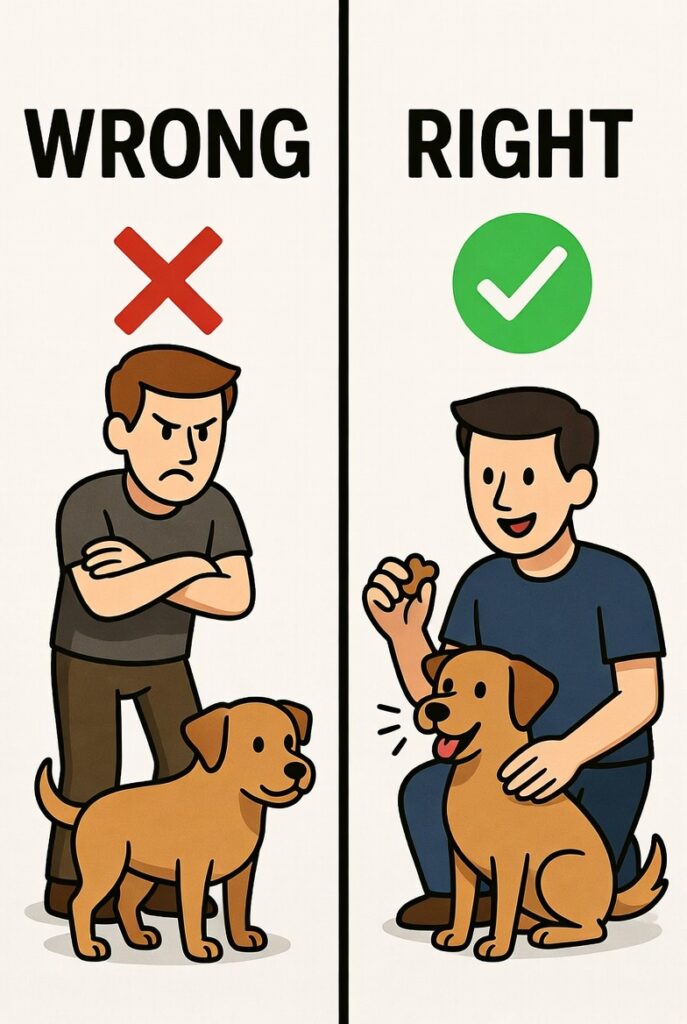
| Mistake | Why It Hurts Training | Better Alternative |
| Yelling or harsh corrections | Creates fear and breaks trust | Stay calm, redirect, and reward good behavior |
| Long training sessions | Causes frustration and mental fatigue | Keep sessions to 5–10 minutes maximum |
| Repeating commands | Trains your dog to ignore the first cue | Say it once, wait, lure if needed, then reward |
| Too many commands at once | Overwhelms and confuses the dog | One command at a time, mastered before moving on |
| Inconsistent family rules | Sends mixed signals the dog cannot decode | All household members use the same words and rules |
| Rewarding bad behavior | Reinforces exactly the wrong behavior | Never reward whining, jumping, or barking for attention |
Repeating Commands Too Many Times
If you say “sit, sit, SIT” before your dog complies, you are teaching them that the first two cues do not require a response. Say the command once, wait a moment, and use a lure if they do not respond. Reward the correct behavior quickly.
Punishing Instead of Redirecting
Punishment — especially physical correction — creates fear and damages your relationship with your dog. It also fails to teach the dog what you want them to do instead. Redirect unwanted behavior toward the correct behavior, then reward that. This is how dogs actually learn.
Expecting Perfect Results Too Quickly
Dogs are not robots. Some days will go better than others. Progress is not always linear — regression is completely normal. If your dog seems to have forgotten something they knew before, go back a step, make it easier, and rebuild from there.
Inconsistent Rules Between Family Members
If one person lets the dog on the sofa and another does not, the dog lives in constant confusion. Call a quick family meeting. Decide on rules and command words together before you begin training.
Accidentally Rewarding Bad Behavior
Giving a jumping dog attention — even pushing them away — is a reward. Letting a barking dog outside to quiet them reinforces barking. Look carefully at what happens immediately after every unwanted behavior and ask whether you are accidentally making it stronger.
Beginner vs Advanced Dog Training: What to Focus on First
Understanding where you are in the training journey helps you set realistic, achievable goals. Here is how beginner and advanced training compare.
| Beginner Training Goals | Advanced Training Goals |
| Sit | Off-leash recall in distracting environments |
| Stay | Agility course work |
| Come | Complex chained tricks |
| Leash manners | Calm behavior in busy public spaces |
| Potty training | Advanced obedience competition |
| Name recognition | Service dog task work |
Focus entirely on the beginner column for the first two to three months. Mastering the basics thoroughly creates a solid platform for everything that comes after. A dog with a reliable Sit, Stay, and Come across different environments is already far ahead of most pet dogs.
Free Dog Training Resources That Actually Help
You do not need to spend money to access excellent training guidance. Here are the best free resources available right now.
- YouTube — the single best free dog training resource available. Thousands of practical, step-by-step training videos from certified trainers.
- Free printable training charts — many pet blogs and training websites offer downloadable command charts you can stick on your fridge for quick reference.
- Puppy schedule templates — free printables that map out daily feeding, potty breaks, training, and sleep times. Essential for new puppy owners.
- Training tracker apps — apps like Dogo offer free basic training plans and progress tracking specifically designed for beginners.
- Local community groups — check Facebook Groups or Nextdoor for local dog training meetups, free community workshops, or training parks in your area.
Best Dog Training Videos and Channels for Beginners
YouTube has a massive amount of dog training content — not all of it good. Here is how to find what works and how to use it without accidentally confusing your dog.
Best Channels for Basic Dog Commands
Zak George’s Dog Training Revolution is one of the most beginner-friendly channels available. His videos are organized by skill level, he uses positive reinforcement throughout, and his explanations are clear and direct. The channel includes playlists specifically built for new dog owners and puppy training.
Best Channels for Puppy Training
McCann Dog Training on YouTube has a dedicated puppy series covering early socialization, basic commands, and crate training in an organized, easy-to-follow format. Their content avoids overwhelming beginners with advanced concepts too early.
Best Channels for Dog Behavior Problems
Victoria Stilwell’s channel and her show It’s Me or the Dog provide detailed guidance on common behavior problems like jumping, barking, and leash pulling. Her methods are force-free and science-based, and she explains not just what to do but why the dog is doing the problem behavior in the first place.
How to Use YouTube Dog Training Videos Without Confusing Your Dog
• Stick to one trainer’s method at a time — different trainers sometimes use different cues for the same behavior
• Watch the full video before trying it with your dog — know all the steps before you start
• Do not switch trainers midway through teaching a skill — pick one method and follow it through to the end
• Pause and practice in short bursts rather than binge-watching and then attempting a marathon session
The American Kennel Club (AKC) at akc.org also maintains a free library of beginner training guides, command videos, and breed-specific training advice worth bookmarking.
When Home Dog Training Is Not Enough
Home training is powerful, but it has limits. Knowing when to seek professional help is part of being a responsible dog owner.
Signs You May Need a Professional Trainer
• Your dog has bitten someone or shown serious aggression toward people or other animals
• Training sessions consistently end in frustration for both you and your dog
• Fear responses are escalating rather than improving over time
• Your dog cannot settle or relax at any point during the day
Aggression or Fear-Based Behaviors
Growling, snapping, or biting — even if it seems minor — should always be evaluated by a certified professional. These behaviors have underlying causes that require careful assessment. Trying to suppress them without addressing the root cause can make the situation significantly worse.
Severe Separation Anxiety
Some dogs experience genuine distress when left alone — not just boredom, but panic. Signs include destructive behavior, excessive vocalization, and attempts to escape. A certified separation anxiety trainer (CSAT) can build a customized desensitization protocol tailored to your specific dog.
Resource Guarding
If your dog growls or snaps when approached near food, toys, or sleeping spots, this needs professional attention. Resource guarding can escalate quickly and should not be managed with punishment-based approaches.
Reactivity Around Other Dogs
Some dogs lunge, bark, or completely lose composure around other dogs on walks. Mild reactivity can improve at home with the right approach, but moderate to severe cases benefit significantly from working with a trainer who specializes in reactivity protocols.
📋 Finding Help: Look for a trainer certified through the Certification Council for Professional Dog Trainers (CCPDT) or the International Association of Animal Behavior Consultants (IAABC). Avoid trainers who rely primarily on pain-based or punishment-based methods.
Home Dog Training Checklist
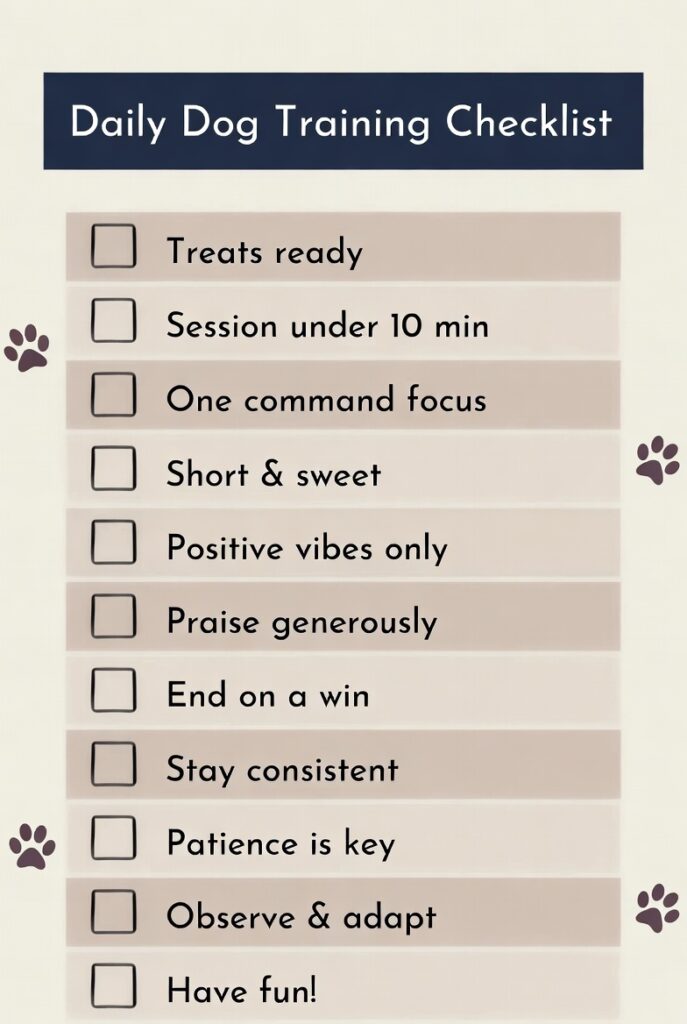
Use this checklist before and during every training session to set yourself up for success.
☐ Treats ready — small, soft, high-value pieces prepared in advance
☐ Training space is quiet and free of major distractions
☐ Session length planned — 5 to 10 minutes maximum
☐ One command chosen as today’s primary focus
☐ Clicker ready (if using one)
☐ All family members know today’s training word for consistency
☐ Dog is not overtired, overhungry, or overstimulated before the session
☐ Every session ends on a success — even a very small one
☐ Progress noted — keep a simple one-line daily log
☐ Staying patient — if frustration builds, take a break and return later
Final Action Plan: How to Start Training Your Dog Today
You now have everything you need. Here is your simple action plan to begin today — no overthinking required.
Step 1: Pick one command — start with Sit. It is the easiest and opens the door to everything else.
Step 2: Set a 5-minute daily routine — morning is ideal, tied to breakfast feeding.
Step 3: Prepare your treats — cut them small, keep them in a bowl near your training spot.
Step 4: Practice in the same spot each day for the first week — familiarity builds confidence.
Step 5: Track your dog’s progress in a simple notes app or journal — even one line per day.
Step 6: Add one new command every five to seven days once the current one is reliable.
Step 7: After two weeks, review the 14-day schedule and adjust based on what your dog has learned.
That is genuinely all you need to begin. The dogs that make the fastest progress are not the ones with the most talented owners. They are the ones with the most consistent ones.
✅ Remember: Short. Daily. Positive. Those three words summarize everything you need to know about how to train a dog at home effectively.
Frequently Asked Questions
How do I start training my dog at home?
Start by building trust over the first day or two — hand-feed meals and spend calm time together. Then introduce Sit as your first command using a treat lure. Keep sessions to five minutes, twice a day. Reward within two seconds of the correct behavior. Once Sit is reliable, add Stay. Build from there one command at a time.
What is the easiest command to teach a dog first?
Sit is almost universally the easiest first command. It is a natural position that can be easily lured with a treat, and the learning time is typically just one to three days with consistent practice. It also serves as the foundation for Stay, Wait, and many other commands.
How long does it take to train a dog at home?
Basic commands like Sit and Come can be learned in a few days to a couple of weeks. A solid foundation of five to seven commands typically takes four to eight weeks of consistent daily practice. Reliable behavior in distracting environments — what trainers call proofing — can take three to six months. There is no single timeline — it depends on the dog’s age, breed, personality, and how consistently you train.
Can older dogs still be trained?
Absolutely. The idea that older dogs cannot learn new behaviors is a myth. Adult and senior dogs can learn new commands — they often have longer attention spans than puppies. The main difference is that older dogs may have established habits that take longer to replace. Patience and positive reinforcement are especially important.
How many minutes per day should I train my dog?
For most adult dogs, two to three sessions of five to ten minutes per day is ideal — a total of ten to thirty minutes spread throughout the day. For puppies under four months old, three to five minutes per session is plenty. Training too long causes frustration and actually slows progress.
What treats work best for dog training?
The best training treats are small (pea-sized), soft, and smelly. Soft treats can be eaten quickly without interrupting the training flow. Popular options include small pieces of cooked chicken, diced cheese, commercial training treats like Zukes Mini Naturals, hot dog slices, or freeze-dried meat. For learning a new behavior, always use high-value treats. For practicing commands the dog already knows, lower-value treats are fine.
What should I do if my dog ignores commands?
First, check your environment — if it is too distracting, move somewhere quieter. Second, check your treat value — your dog may not find the current reward motivating enough. Third, go back a step and make the behavior easier to succeed at. Finally, make sure you are saying the command only once and giving your dog enough time to respond before reaching for the lure.
Can I train my dog without a clicker?
Yes. A clicker is a useful tool but not a requirement. You can use a marker word instead — a short, sharp sound like “yes” spoken the moment your dog does the right thing. The marker word works just like a clicker: it bridges the gap between the behavior and the reward. What matters is that your marker is consistent and always delivered within one to two seconds of the correct behavior.
Are free dog training videos effective?
Yes, significantly so — provided you pick a single trainer’s method and follow it consistently. Channels like Zak George’s Dog Training Revolution provide structured, beginner-friendly content that has helped millions of dog owners successfully train at home. The key is picking one approach and sticking with it rather than jumping between different methods and cues.
When should I hire a professional dog trainer?
Consider professional help if your dog shows aggression, fear-based behaviors that are worsening, severe separation anxiety, or resource guarding. Also consider it if home training consistently creates frustration for both of you, or if progress has completely stalled after several weeks of consistent effort. Look for trainers certified through the CCPDT or IAABC who use positive, force-free methods.
Final Thoughts
Learning how to train a dog at home is one of the most rewarding things you can do as a dog owner. It strengthens the bond between you and your dog, builds trust on both sides, and creates a safer and more enjoyable life for your entire household.
You do not need perfect conditions. You do not need expensive tools. You do not even need a lot of time. What you need is consistency, patience, and the willingness to show up for five minutes every single day.
Start with Sit. Build from there. Be kind to your dog when they get it wrong and enthusiastic when they get it right. Most dogs genuinely want to learn — they just need a clear and consistent teacher.