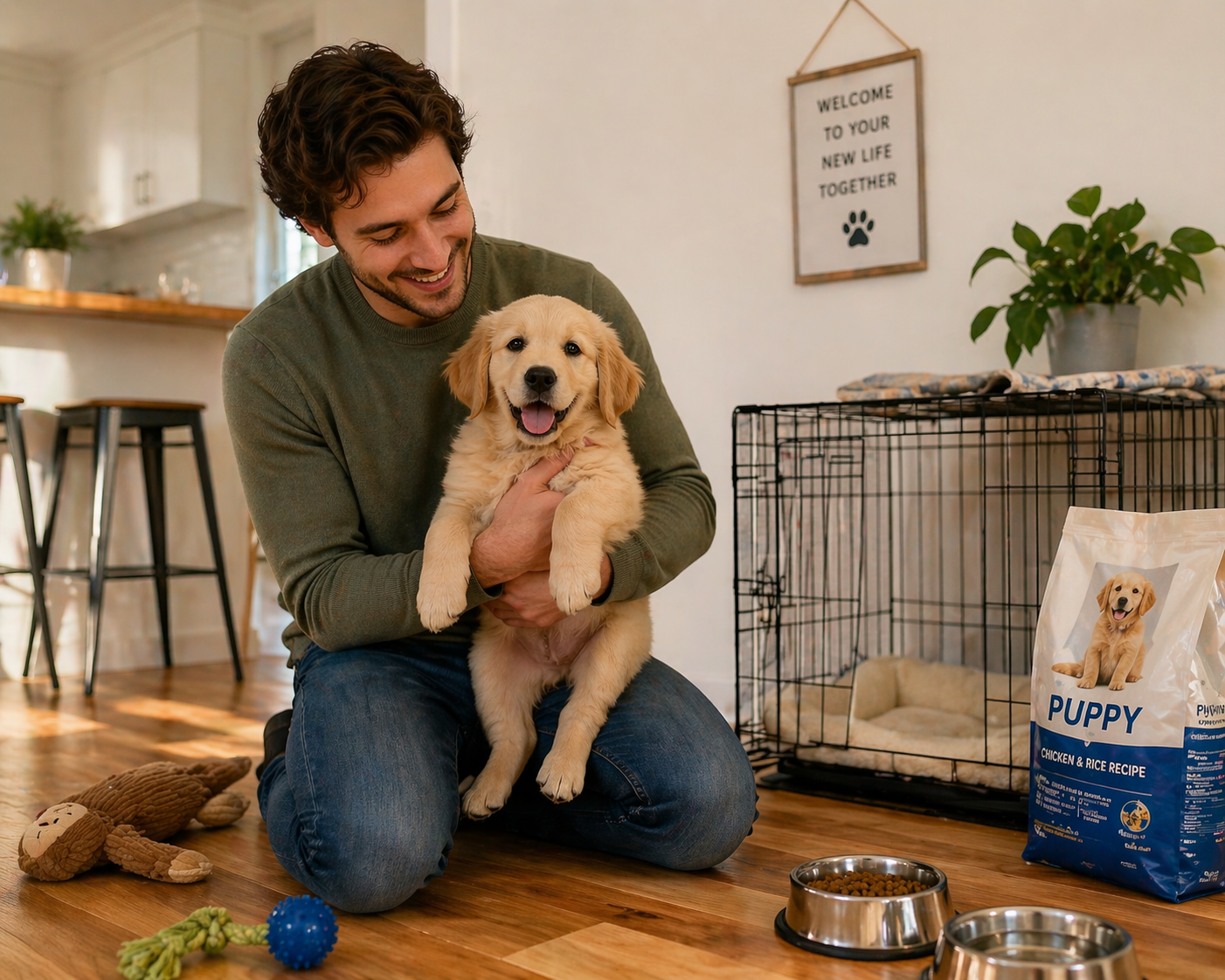
I still remember the day I brought home my first puppy. I thought I was prepared — food bought, collar on order, cozy corner picked out. What I didn’t have was any real plan. Within 24 hours there were accidents on the floor, chewed shoes under the couch, and one very overwhelmed new dog owner staring at the ceiling wondering what went wrong.
The truth is, most people underestimate how much goes into those first days. However, it’s not because getting a puppy is impossibly complicated — it’s because nobody gives you a clear, complete puppy checklist that covers every angle. That’s exactly what I’ve built here.
This guide walks you through everything: from what to buy before your puppy arrives, to how to puppy-proof your home, set up a first-week routine, start training, and prepare for that critical first vet visit. Whether you’re a first-time owner or adding a second dog to your family, this new puppy checklist will save you from the chaos I went through.
Here’s how to use this guide: scan the Quick Summary first if you’re short on time, then work through each section based on where you are in your journey. The final section gives you a master checklist you can print or save as a PDF.
Related Read: Dog as a Pet: Everything You Need to Know Before Getting One
Quick Puppy Checklist Summary (Save This First)
The Complete At-a-Glance Puppy Checklist
Before diving into full detail, here’s the overview that covers every core category. Think of this as your fast-reference card — the complete puppy checklist at a glance:
| Category | What You Need |
| Supplies & Gear | Crate, bed, food/water bowls, collar, leash, ID tag, poop bags |
| Nutrition | Age-appropriate puppy food, feeding schedule, training treats |
| Hygiene & Grooming | Shampoo, nail clippers, brush, potty pads, enzymatic cleaner |
| Toys & Enrichment | Chew toys, interactive puzzle toys, tug toys |
| Home Safety | Baby gates, cord covers, toxic plant removal, safe zones |
| Training Essentials | Clicker, treat pouch, training mat, crate training plan |
| Health & Vet | Vet appointment booked, vaccine records ready, deworming schedule |
| Socialization Plan | Exposure list for sounds, people, environments (8-16 weeks) |
| Daily Routine | Feeding, potty, play, nap, and training times mapped out |
Must-Have vs Nice-to-Have Items (Avoid Overbuying)
One of the most common mistakes I see new owners make is overbuying. They arrive home with three types of beds, four leashes, and a basket full of toys the puppy ignores for weeks. Therefore, let me break this down clearly so you don’t waste money upfront on this puppy checklist to buy:
| Item | Must-Have? | Why |
| Crate (wire or plastic) | YES – Get It | Essential for toilet training and safe sleeping |
| Food & water bowls | YES – Get It | Non-negotiable — get stainless or ceramic |
| Collar + ID tag | YES – Get It | Required for safety from Day 1 |
| Puppy food (correct formula) | YES – Get It | Wrong food causes digestive problems immediately |
| Enzymatic cleaner | YES – Get It | You will need this for accidents — guaranteed |
| Fancy raised dog bed | WAIT | Puppies chew and destroy beds — start simple |
| Designer harness set | WAIT | A basic collar works fine early on |
| Elaborate toy collection | WAIT | Start with 3-4 quality toys, add later |
Downloadable & Printable Checklist Options (PDF/Print Use Case)
If you’re the type who likes to work from a printed sheet — and I genuinely recommend it — a puppy checklist printable is a game-changer. You can tick items off as you go, which prevents anything falling through the cracks during a stressful first week.
At the end of this guide I’ve included a master checklist covering pre-arrival, first week, and first month milestones. You can copy it into a document, print it, or save it as a new puppy checklist PDF for offline use. For those searching ‘puppy checklist UK’ or ‘puppy checklist Australia’ — the core content applies globally, though I’ll flag regional differences where relevant, such as mandatory microchipping laws in the UK.
| Quick Tip: Bookmark this page or screenshot the master checklist at the end — it’s the most practical part of this entire guide. |
Who This Puppy Checklist Is For
First-Time Puppy Owners vs Experienced Dog Owners
If you’re a first-time owner, this getting a puppy checklist is built with you in mind. I’ve intentionally explained the ‘why’ behind every recommendation rather than just listing items. You deserve context, not just commands.
However, even if you’ve raised dogs before, I’d encourage you to read the training and socialization sections carefully. In my experience, the biggest mistake experienced owners make is assuming a new puppy will ‘figure it out’ by following the older dog in the house. Each puppy is different, and each one needs a fresh approach.
Related Read: Best Dog Breeds for First-Time Owners: Top 15 Picks
Apartment Living vs House Owners (Different Needs)
Your living situation genuinely changes what you need on this puppy checklist. For example, apartment owners need to think carefully about potty training logistics — you can’t just open a back door. Puppy pads become critical in the early weeks. You’ll also need to plan quiet enrichment options for noise-sensitive neighbours.
House owners, on the other hand, have more freedom but also more hazards — larger yards, garden chemicals, fences with gaps. Therefore, the puppy-proofing section of this guide matters most for you. Both situations work perfectly well — you just prepare differently.
Busy Professionals vs Stay-at-Home Owners
One of the most honest conversations in the puppy world is around time commitment. If you’re working full-time, a puppy requires real planning. You’ll need a dog walker, puppy daycare, or a trusted family member to cover the critical first 8-12 weeks.
In my experience, puppies left alone for more than 3-4 hours consistently in the early weeks develop anxiety, destructive habits, or potty training setbacks. This isn’t meant to scare you — it’s meant to help you plan realistically before the puppy arrives, not after.
Related Read: Low-Maintenance Dog Breeds for Busy People
What Actually Matters Before Bringing a Puppy Home
The 3 Critical Areas Most People Ignore (Environment, Routine, Training)
Most people focus only on buying things. However, in my experience, the three areas that determine puppy success have very little to do with the most expensive gear.
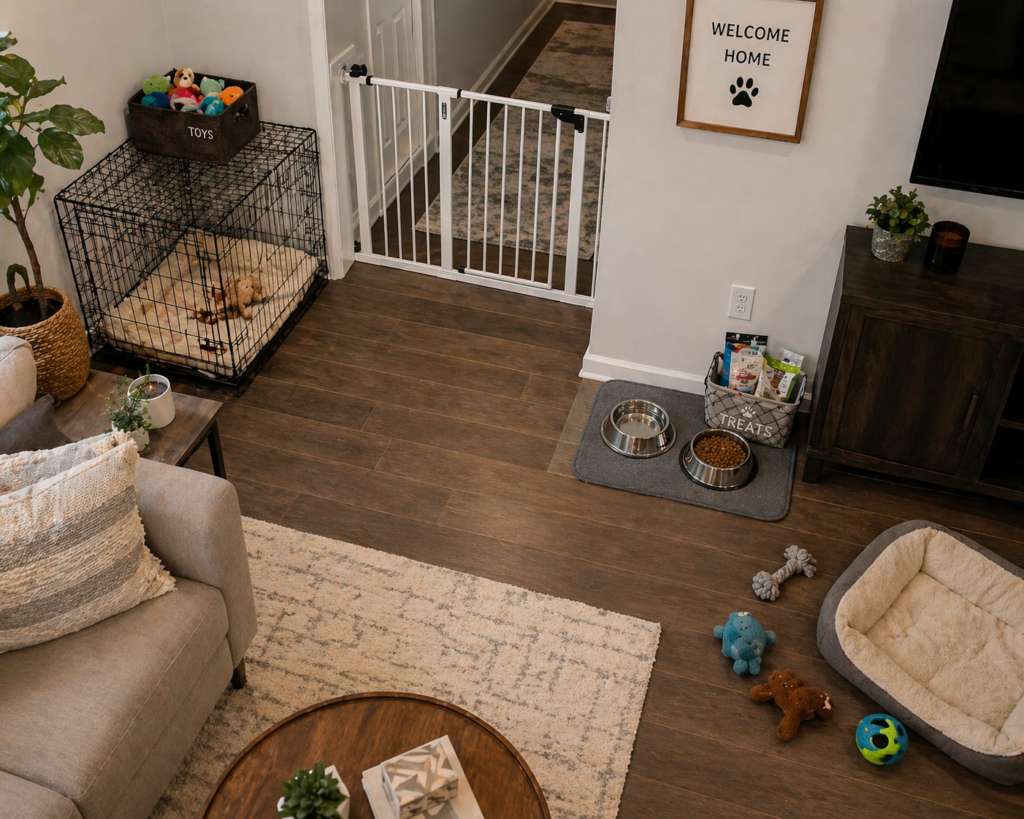
First: Environment. A puppy’s brain is developing at lightning speed. A chaotic, unstructured environment creates a stressed, reactive dog. A calm, clear environment creates a confident one. Before your puppy arrives, create a designated safe zone — a small supervised area where they begin their first days.
Second: Routine. Puppies thrive on predictability. Feeding at the same time, potty trips at the same intervals, naps in the same place — all of this builds a puppy that feels secure and learns faster. I’ve seen puppies toilet train in under two weeks simply because the owner was disciplined about routine.
Third: Training Foundation. You don’t wait until Week 2 or 3 to start training. From Day 1, every interaction teaches the puppy something. The question is whether what you’re teaching is intentional or accidental.
| Key Insight: The environment you create before your puppy arrives is more important than any toy or product you buy. Get this right first. |
Timeline: What to Prepare 7 Days Before vs 1 Day Before
Here’s the preparation timeline I recommend based on years of working with new puppy owners. Use this as your bringing home a puppy checklist for pre-arrival planning:
| Timeframe | Task | Priority |
| 7 days before | Buy all core supplies: crate, bowls, collar, food | Critical |
| 7 days before | Puppy-proof your home room by room | Critical |
| 7 days before | Book your first vet appointment | Critical |
| 7 days before | Research feeding schedules and pick a food brand | Important |
| 3 days before | Set up the crate with bedding in its permanent spot | Critical |
| 3 days before | Remove toxic plants, secure all loose wires | Critical |
| 1 day before | Request a worn breeder item to place in the crate (scent aid) | Important |
| 1 day before | Prep enzymatic cleaner and potty pad station | Critical |
Common Planning Mistakes That Cause Stress Later
These planning errors are extremely common — and every single one is avoidable with a bit of foresight:
- X Not booking a vet appointment before the puppy arrives — slots fill fast
- X Setting up the crate in a high-traffic area instead of a quiet corner
- X Buying adult dog food instead of a puppy-specific formula
- X Skipping socialization window research entirely
- X Assuming the puppy will naturally learn house rules without guidance
Essential Puppy Supplies Checklist (What to Buy First)
Core Daily Essentials (Food, Bowls, Crate, Bed)
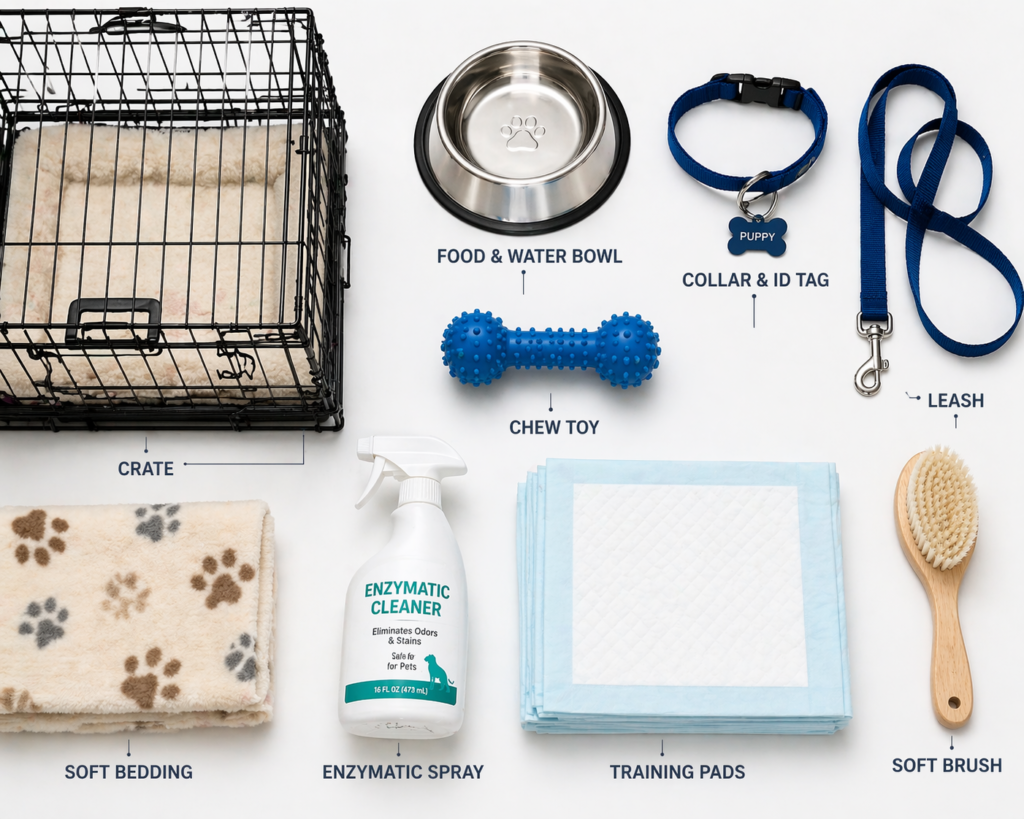
This is the non-negotiable core of your puppy checklist items — the puppy supply checklist that gets used every single day. Get these right before anything else:
- ✓ Puppy-specific food — kibble or wet, age and breed appropriate
- ✓ Stainless steel or ceramic food and water bowls — avoid plastic (bacteria harbors in scratches)
- ✓ Wire crate sized for adult weight with a divider panel — don’t go too large too fast
- ✓ Washable crate mat or fleece blanket
- ✓ Basic flat collar with breakaway safety feature
- ✓ ID tag engraved with your phone number — ready before Day 1
- ✓ Poop bags in bulk — you’ll use far more than you anticipate
On food specifically — this is one area where I’d spend more rather than less. A quality puppy food supports brain development, coat health, and digestion. It also means fewer vet visits in Year 1. Look for a named protein source like ‘chicken’ or ‘salmon’ as the first listed ingredient.
Related Read: Best Puppy Feeding Schedule: How Much and How Often to Feed -> https://thepawpets.com/best-puppy-feeding-schedule/
Safety & Control Items (Leash, Collar, ID Tags)
A properly fitted collar and solid leash are essential from the very first day. However, many new owners skip the ID tag — and that’s a risk I’d never take. Even puppies can slip away in the confusion of arriving at a new home.
- ✓ Standard flat collar — adjustable for growth, check fit weekly in the first 3 months
- ✓ 4-6 ft standard leash — avoid retractable for puppies (they teach pulling)
- ✓ Backup harness — useful for puppies who slip collars or resist leash pressure
- ✓ ID tag with your name, phone number, and optionally your address
- ✓ Microchip appointment booked — legally required in the UK from 8 weeks, recommended everywhere
Hygiene & Grooming Essentials (Shampoo, Pads, Cleaning Supplies)
Grooming from a young age builds tolerance and makes your life significantly easier long-term. Additionally, a clean environment is critical for a puppy’s health. Therefore, don’t underestimate the cleaning supplies — they’re among the most-used items in the early weeks.
- ✓ Puppy-formulated shampoo — adult dog shampoo can be too harsh for young skin
- ✓ Soft slicker brush or grooming glove — breed dependent
- ✓ Nail clippers or grinder — start touching paws from Day 1 so they get used to it
- ✓ Enzymatic cleaner for accidents — the only thing that actually eliminates odours
- ✓ Puppy training pads — especially useful for apartment living
- ✓ Old towels dedicated to puppy use only
Toys That Actually Help Development (Not Just Entertainment)
Not all toys are equal. In my experience, the best puppy toys serve a developmental purpose — they reduce anxiety, satisfy natural urges, and build mental stimulation. Here’s what I actually recommend based on results:
- ✓ Rubber chew toy like a Kong — fill with kibble or peanut butter for extended engagement
- ✓ Rope tug toy — great for bonding and teaching bite pressure when used correctly
- ✓ Crinkle or squeaky toy — satisfies natural prey drive in a safe, controlled way
- ✓ Snuffle mat or puzzle feeder — mental stimulation reduces destructive behaviour
- ✓ Avoid: toys with small detachable parts, very hard plastic, or toys too large to manipulate
Budget vs Premium Options (What’s Worth Spending On)
You don’t need to spend a fortune. However, there are specific areas where going cheap ends up costing you significantly more in the long run. Here’s my honest breakdown:
| Item | Budget OK? | Why It Matters |
| Crate | Budget OK | Wire crates are similar across price points |
| Collar & leash | Budget OK | Basic nylon works perfectly in early months |
| Puppy food | Spend more | Quality protein means fewer health issues long-term |
| Enzymatic cleaner | Spend more | Cheap versions don’t eliminate odour — puppy returns to same spot |
| Vet visits | Never cut | Prevention is always cheaper than emergency treatment |
| First bed | Budget first | Puppies chew — start simple, upgrade at 6 months |
Related Read: Puppy Essentials Checklist: Every Item Ranked by Importance
Puppy-Proofing Your Home (Before Day One)
Room-by-Room Puppy Proofing Checklist
The puppy proofing house checklist is one of the most important — and most underestimated — parts of preparing for a new puppy. A curious puppy investigates everything with their mouth. Therefore, your job is to make every accessible space safe before they step through the door.
Room: Kitchen
- ✓ Secure low cabinet doors using child-proof locks
- ✓ Keep cleaning products, dishwasher tablets, and medications in locked cabinets
- ✓ Trash can with a secured lid or moved to an inaccessible location
Room: Living Room
- ✓ Bundle and secure electrical cords behind furniture or in cord covers
- ✓ Remove low-lying decorative items the puppy could swallow
- ✓ Block under-sofa gaps where puppies hide and chew in secret
Room: Bathroom
- ✓ Keep the toilet lid closed at all times
- ✓ Remove accessible grooming products, razors, and all medications
- ✓ Check for small items on low shelves that could be swallowed
Room: Garden / Yard
- ✓ Check fence integrity — puppies squeeze through surprisingly small gaps
- ✓ Remove toxic plants: azalea, foxglove, daffodil bulbs, and others
- ✓ Secure fertilizers, weedkillers, and garden tools completely out of reach
Hidden Dangers Most Owners Miss
Beyond the obvious hazards, there are a few dangerous items that catch even experienced owners off guard. In my experience, these are the ones most likely to result in an emergency vet visit — often from a completely avoidable situation:
! Xylitol — artificial sweetener found in certain peanut butters, gum, and sugar-free products: highly toxic
! Grapes and raisins — even small amounts can cause kidney failure in dogs
! Common houseplants — pothos, peace lily, and aloe vera are all toxic to puppies
! Loose coins — zinc toxicity from swallowing coins is more common than most people realise
! Children’s toys with small parts — a forgotten building block is a swallowing hazard
! Laundry pods — highly concentrated and extremely dangerous if punctured or chewed
Safe Zones vs Restricted Zones Setup
Rather than giving your puppy full house access on Day 1, I strongly recommend a zone-based approach. This is one of the most effective strategies on any bringing home a puppy checklist and consistently produces the best early results.
Create a ‘puppy zone’ — typically one or two rooms where the puppy spends supervised time in the first few weeks. Use baby gates to block stairways and restrict access to rooms you haven’t fully puppy-proofed. As the puppy earns trust through good behaviour and solid toilet training progress, gradually expand access. This phased approach prevents accidents and builds confidence simultaneously.
| Expert Insight: The puppy zone concept reduces accidents by 60-70% in the first week. Start small and expand access as a reward for good behaviour — never as a default. |
First Week With Your Puppy: Step-by-Step Setup
Day 1: Bringing Your Puppy Home Without Stress
Day 1 is emotional — for both of you. The puppy has just left their mother, their littermates, and every familiar smell they’ve ever known. Therefore, your primary job on Day 1 is not training. It’s creating calm.
When you arrive home, let the puppy explore the puppy zone quietly at their own pace. Avoid inviting everyone round to meet the new arrival — that can wait 2-3 days. Introduce them to their crate with the door open, let them sniff around, and place a worn clothing item from the breeder inside. That familiar scent provides remarkable comfort in those first hours.
-> Arrive home, take the puppy directly to the designated toilet spot
-> Allow quiet exploration of the puppy zone — no forced interactions
-> Offer water and their first small meal in the new home
-> Introduce the crate with door open — never force entry on Day 1
-> Avoid TV noise, loud music, or overstimulating environments
-> Begin crate sleeping that first night — consistency pays dividends in Week 2
First 3 Days: Building Trust & Routine
The first three days set the emotional tone of your entire relationship with your puppy. Resist the urge to ‘train’ everything at once. Instead, focus on two things: routine and calm connection.
Feed at the same time each day. Take the puppy outside to toilet immediately after every meal, nap, and play session — that single habit is the core of fast potty training. In the evenings, keep interactions calm and predictable. By Day 3, most puppies have already started to pick up the basic rhythm of the household.
Related Read: How to Potty Train a Puppy Fast: Step-by-Step Guide
Week 1 Checklist: Sleep, Feeding, Potty Training Basics
Here’s a condensed first-week checklist to track where you are and what’s still needed:
- ✓ Crate sleeping established — puppy settles within 15 minutes by Night 3
- ✓ Feeding schedule locked in — same times every day without exception
- ✓ Potty routine implemented — outside or pad trips every 1-2 hours
- ✓ First vet appointment completed within 48-72 hours of arrival
- ✓ Puppy’s name response begun — use name before every positive interaction
- ✓ Supervised play sessions of 10-15 minutes, followed by crate naps
- ✓ No punishment for accidents — clean with enzymatic cleaner and move on
Related Read: How to Take Care of a Puppy for Beginners
Puppy Training Checklist That Actually Works in 2026
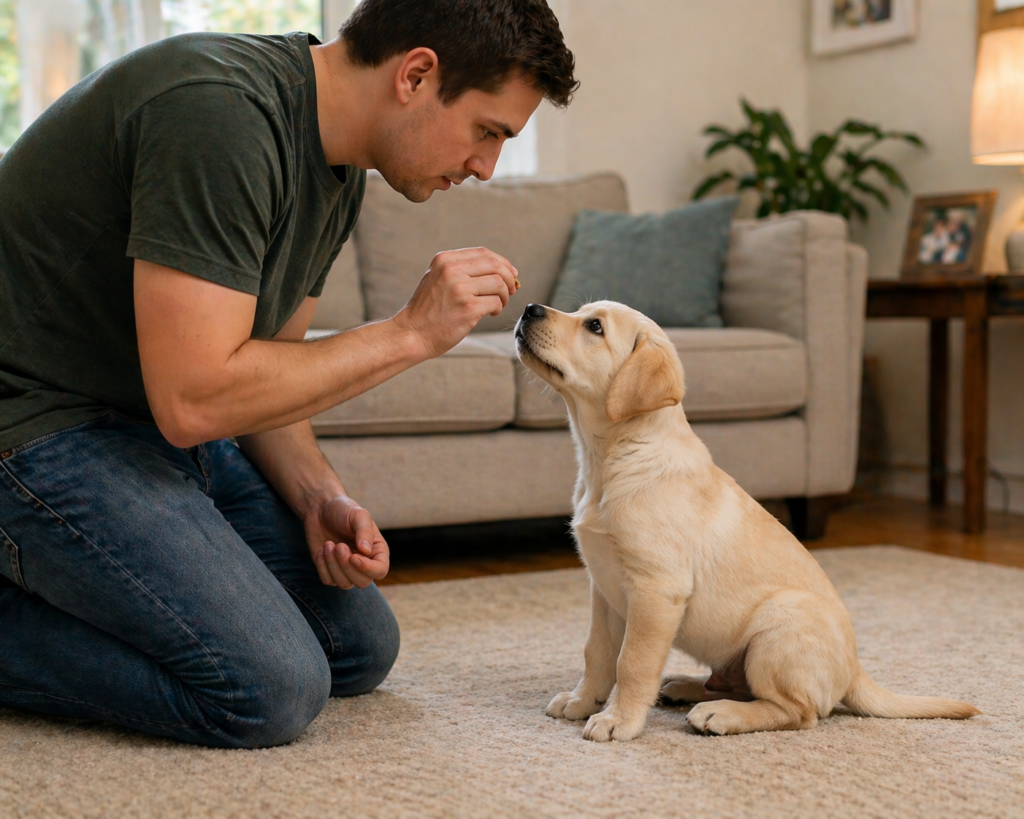
Core Training Foundations (Sit, Stay, Recall, Crate Training)
I’ve tested many training approaches over the years. The most effective one I’ve seen consistently is positive reinforcement — rewarding the behaviour you want to see more of, and redirecting what you don’t. It builds trust rather than compliance based on fear.
Here are the four foundational skills every puppy should start learning in the first week:
| Foundation Skill | How to Start |
| Sit | The gateway command — everything else builds from here. Short 5-second sessions, 3-5x daily |
| Name recall | Say their name, reward eye contact. Do this 20-30 times in the first few days |
| Crate training | Treat the crate as a positive space from Day 1 — never as punishment |
| Bite inhibition | Allow gentle mouthing, yelp or redirect if pressure increases — critical for long-term safety |
Daily Training Routine for Fast Progress
Consistency is the single most important factor in puppy training — and short sessions beat long ones every time. Five sessions of 3-5 minutes each day produces dramatically faster results than one 30-minute session. A puppy’s attention span is limited, so therefore you work with that reality rather than against it.
- Morning — 5 minutes before breakfast (use kibble as reward to offset treats)
- Post-walk — 5 minutes while calm energy is at its lowest
- Midday — crate rest, then 5-minute name recall practice
- Evening — 5-minute recap of all commands learned so far
- Bedtime — calm crate entry practice only (no exciting play before sleep)
Related Read: Puppy Training Schedule: Week-by-Week Training Guide and How to Train a Dog at Home: Complete Step-by-Step Guide
Common Training Mistakes That Slow Progress
These mistakes are extremely common in the first weeks — and every single one is preventable with a bit of awareness upfront:
- X Training when the puppy is tired or just woken up — wait for calm alertness
- X Repeating commands multiple times before the puppy complies — teaches them to ignore the first ask
- X Using punishment after accidents — creates fear, not understanding
- X Inconsistency between family members — agree on rules before the puppy arrives, not after
- X Stopping training at 12 weeks because ‘they know the basics’ — the teenage phase needs continued work
Puppy Socialization & Exposure Checklist (By Age)
Why Early Socialization Is Critical (And Often Done Wrong)
The socialization window — roughly 3 to 16 weeks — is one of the most scientifically well-documented periods in dog development. During this time, a puppy’s brain is actively building associations with the world around them. Positive exposure now means a calmer, more confident dog for life.
However, most owners get this wrong in one of two ways. Either they do nothing and the puppy misses the window entirely, or they go too far too fast and overwhelm the puppy — creating fear rather than confidence. The goal is controlled, positive exposure. Not flooding.
| Critical Window: The socialization window closes around 16 weeks. After that, the brain becomes significantly less receptive to new experiences. Missing this window is recoverable — but it’s much harder. |
Socialization Checklist by Age (8-16 Weeks)
Here’s a puppy socialization checklist by age that I recommend following as closely as your puppy’s vaccination schedule allows:
| Age Range | Socialization Focus |
| 8-10 weeks | Home sounds (vacuum, TV, doors), gentle handling of paws, ears, mouth, meeting calm adults |
| 10-12 weeks | Meeting children (supervised), car journeys, different floor surfaces, friendly vaccinated dogs |
| 12-14 weeks | Busy environments (markets, parks), bicycles and joggers, meeting calm strangers |
| 14-16 weeks | Puppy classes, off-lead play with appropriate dogs, exposure to livestock if relevant |
Exposure Checklist: Sounds, People, Environments
Use this puppy exposure checklist to ensure you’re covering all major categories. The goal is a confident adult dog that isn’t startled by everyday life:
Category: Sounds
- ✓ Vacuum cleaner
- ✓ Doorbell
- ✓ Fireworks (via recording)
- ✓ Thunder sounds
- ✓ Road traffic
- ✓ Children playing
Category: People
- ✓ Men with beards
- ✓ Children under 5
- ✓ People in hats or uniforms
- ✓ Elderly people with walking aids
- ✓ Visitors arriving at the door
Category: Environments
- ✓ Pavements and roads
- ✓ Parks with other dogs
- ✓ Pet-friendly shops
- ✓ Car rides
- ✓ Veterinary clinic (positive visit before any procedures)
Puppy Health & First Vet Visit Checklist
What to Prepare Before the First Vet Visit
Your puppy’s first vet visit is one of the most important appointments you’ll make. Ideally, book this within 48-72 hours of bringing the puppy home. Here’s your puppy first vet visit checklist to arrive fully prepared:
- ✓ Bring any health records from the breeder: vaccination history, deworming dates, breed health tests
- ✓ Note down any questions about nutrition, schedule, or behaviour you’ve already observed
- ✓ Bring a fresh stool sample in a sealed bag if the vet requests parasite screening
- ✓ Ask about the recommended local vaccination schedule (varies by country and region)
- ✓ Discuss microchipping if not already completed
- ✓ Ask about pet insurance options — do this before anything medical happens
Vaccination, Deworming & Health Tracking Basics
Puppies need a series of vaccinations in the first few months of life. However, the exact schedule depends on your location and the puppy’s starting history. As a general framework that applies in most countries:
| Age / Frequency | Health Task |
| 6-8 weeks | First distemper/parvovirus combo — usually done by breeder |
| 10-12 weeks | Second round — core vaccines (DHPP or similar protocol) |
| 14-16 weeks | Third round — final puppy series, often includes rabies where required |
| 12-16 weeks | Rabies vaccine — legally required in many countries including the US |
| Every 1-3 yrs | Boosters — vet will advise based on titer tests or standard protocol |
| Every 2-4 wks | Deworming — typically 3 rounds in the first 6 months of life |
Red Flags: When to Visit the Vet Immediately
Knowing when not to wait is just as important as following the scheduled health milestones. These signs require same-day or emergency vet attention — don’t adopt a wait-and-see approach with any of them:
! Lethargy combined with loss of appetite lasting more than 12 hours
! Bloody diarrhoea or vomiting more than twice in a short period
! Suspected ingestion of a toxic substance — don’t wait for symptoms to appear
! Difficulty breathing, pale gums, or sudden collapse
! Swollen abdomen that appeared rapidly or without explanation
! Seizures of any kind or duration
Beginner vs Advanced Puppy Preparation Strategy
Beginner Approach (Simple, Minimal Setup)
If this is your first puppy and you’re feeling overwhelmed, here’s the honest truth: you don’t need to do everything at once. The beginner approach is intentionally lean — focused on getting the most important things right and not overcomplicating the rest in those critical first weeks.
- ✓ Set up one core safe zone — don’t try to manage the whole house from Day 1
- ✓ Buy only the must-have supplies list — nothing else yet
- ✓ Focus on one training goal per week: Week 1 name, Week 2 sit, Week 3 recall
- ✓ Commit to a consistent feeding and toilet schedule above all other priorities
- ✓ Find one good puppy class in your area and book it early
Advanced Approach (Optimised Training & Environment)
For owners who’ve done this before, or who want to set an exceptionally strong foundation from the start, here’s where to go deeper with your preparing for a puppy checklist:
-> Set up a structured enrichment rotation — different toys on different days to prevent boredom
-> Implement deliberate calm handling sessions to build body awareness and vet-visit confidence
-> Follow a structured socialization plan week by week with a written exposure log
-> Start conditioning cues for grooming from Week 1: towel, blow dryer, clipper sounds
-> Use a training journal to track progress, regression points, and behaviour patterns
Related Read: Puppy Care for Beginners: The Complete Step-by-Step Guide
When to Upgrade Your Setup Over Time
You don’t need everything from day one — and in fact, buying too much too soon often creates clutter and confusion. Here’s a rough upgrade timeline based on typical puppy development milestones:
- Month 1-2: Core setup only — crate, zone, routine, basic training commands
- Month 3: Introduce puzzle feeders, snuffle mats, and intermediate recall work
- Month 4-5: Consider enrolling in group obedience class; expand zones if potty training is solid
- Month 6+: Re-evaluate all gear — collar size, food formula transition, bed quality upgrade
Tools & Resources Smart Owners Use
Best Places to Buy Puppy Supplies (Online vs Local)
Knowing where to shop saves both time and money. For those searching ‘puppy checklist Chewy’ or ‘puppy checklist Pets at Home’ — both platforms offer solid selections and often have new puppy starter bundles that provide decent value for first-time buyers.
| Platform | Best For | Notes |
| Chewy (US) | Auto-ship food and medications | Great subscription discounts — set and forget |
| Amazon | Quick delivery, price comparison | Check reviews carefully for lesser-known brands |
| Pets at Home (UK) | In-store advice, puppy packs | Staff are usually well-trained and helpful |
| Local independent | Personalised advice | Often better for specialist and raw food brands |
| Vet clinic shop | Vet-approved products only | Pricier but quality and safety guaranteed |
Apps & Tools for Training, Feeding & Tracking
Technology can genuinely support new puppy owners in 2026. Here are the tools I’ve seen owners use most successfully — and most consistently:
- App: Puppr — structured puppy training videos with integrated clicker
- App: GoodPup — personalised weekly training lessons with live coaching
- App: Dogo — gamified training app with breed-specific training programmes
- App: A simple notes app or spreadsheet — log feeding times, toileting, and sleep to spot patterns
- App: PetDesk — manages vaccine reminders, appointment scheduling, and health records in one place
Community Insights (What Reddit & Owners Recommend)
Searching ‘puppy checklist Reddit’ or ‘new puppy checklist Reddit’ will surface some genuinely useful community threads — r/puppy101 in particular is an outstanding resource for honest, experience-based advice. Sort threads by top comments from the past year for the most relevant perspectives.
The most consistently recommended items across Reddit puppy communities align completely with what I’ve covered here: enzymatic cleaner, a good crate with divider, a quality puppy food, a Kong, and above all — commitment to routine. Nobody on Reddit regrets buying the enzymatic cleaner. Nearly everyone who skipped it wishes they hadn’t.
Common Mistakes That Kill Puppy Progress
Overbuying Unnecessary Items
I’ve seen owners arrive home with an enormous basket of products — most of which sat unused for weeks or were destroyed within days. Therefore, I’ll say it plainly: buying more does not equal being more prepared. The puppy doesn’t care how expensive their bed is. What they care about is whether you show up consistently with calm energy and clear expectations.
The most overrated purchases I’ve seen consistently: designer puppy carrying slings, automated food dispensers used from Day 1 (they delay bonding), breed-specific ‘starter kits’ sold by pet retailers that bundle low-quality items at premium prices, and multiple collar sets bought before you know your puppy’s adult size.
Inconsistent Training & Routine
This is, without question, the single biggest mistake I see with new puppy owners. Inconsistency teaches a puppy that the rules change based on your mood. If jumping up is sometimes funny and sometimes punished, the puppy never learns that jumping is the problem — they learn the environment is unpredictable. That creates anxiety.
Additionally, if one family member allows the puppy on the sofa and another doesn’t, you’re fighting against yourself every single day. Agree on the rules before the puppy arrives. Write them down if you need to. Then stick to them without exception, especially in Week 1 and 2 when the patterns are being set.
Ignoring the Socialization Window
This mistake shows up years later as a reactive dog on a lead, a dog that barks at every visitor, or a dog that can’t cope in new environments. The socialization window doesn’t wait for you to feel ready — it opens at roughly 3 weeks and begins closing at 16 weeks.
I’ve worked with owners whose 3-year-old dogs still struggle with things that could have been resolved with just a few positive exposures before Week 16. Therefore, prioritise socialization even above some of the more advanced training work — especially in those first two months.
| Important Warning: Missed socialization is fixable — but it takes months or years of careful, often professional work. The window costs you nothing but time. Don’t let it close unused. |
Complete Puppy Checklist (Actionable Master List)
This is the master list you’ve been building toward throughout this guide. Print it, bookmark it, or save it as your new puppy checklist PDF. It’s designed to be used directly — not just read once and forgotten.
Pre-Arrival Checklist
- ✓ Buy crate with divider — set it up in its permanent location before Day 1
- ✓ Purchase age-appropriate puppy food and stainless/ceramic feeding bowls
- ✓ Buy collar, leash, and have ID tag engraved before arrival day
- ✓ Stock enzymatic cleaner and puppy training pads
- ✓ Puppy-proof the designated puppy zone room by room
- ✓ Remove toxic plants and secure all loose cables and hazards
- ✓ Book first vet appointment for within 48-72 hours of arrival
- ✓ Purchase initial toy set (chew toy, tug toy, puzzle feeder minimum)
- ✓ Set up feeding and toilet schedule in writing before the puppy arrives
- ✓ Contact breeder for health records and vaccination details
- ✓ Research and decide on training approach — positive reinforcement strongly recommended
- ✓ Brief all household members on the agreed rules
First Week Checklist
- ✓ Complete first vet visit — health check, vaccine verification, microchip if needed
- ✓ Crate routine established — puppy settling within 15 minutes at bedtime by Night 3
- ✓ Feeding schedule fixed — same times, same location every single day
- ✓ Potty routine in place — outside or pad every 1-2 hours minimum
- ✓ Name recognition begun — 20-30 positive associations daily
- ✓ Sit command introduced — 3-minute sessions, 3x daily
- ✓ Handled paws, ears, and mouth daily for grooming desensitisation
- ✓ Started socialization log — note what the puppy encountered each day
- ✓ No punishment for any accidents — redirected and cleaned with enzymatic cleaner
- ✓ Supervised all play and interactions — no unsupervised full-house access
First Month Checklist
- ✓ Second vet visit completed — second vaccine round in most protocols
- ✓ Potty training showing consistent progress — fewer than 2 accidents daily by Week 3
- ✓ Recall (name + come) reliably working in low-distraction environments
- ✓ Sit, stay, and down introduced with brief, consistent daily sessions
- ✓ Socialization log shows exposure to at least 10 different people types
- ✓ Puppy sleeping through the night or waking no more than once
- ✓ First grooming session completed — bath and nail check
- ✓ Puppy classes researched and enrolled (starts when fully vaccinated)
- ✓ Puppy zone beginning to expand as toilet training solidifies
- ✓ Pet insurance in place — don’t leave this past the end of Week 1
- ✓ Reviewed and adjusted puppy food quantity as they grow
- ✓ Daily enrichment implemented: puzzle feeder or snuffle mat minimum
FAQ: Real Questions From Puppy Owners
Q: What do I need for a new puppy checklist?
A: The core items are: a crate with divider, food and water bowls, puppy-specific food, collar and ID tag, leash, enzymatic cleaner, a small set of toys (chew, tug, puzzle feeder), and poop bags. Beyond gear, you need a vet appointment booked and a routine planned. Everything else can come later as you understand your specific puppy.
Q: What should I buy before bringing a puppy home?
A: Prioritise the must-haves: crate, bowls, food, collar, leash, ID tag, and enzymatic cleaner. If you’re apartment-based, add training pads. Resist buying everything at once — puppies change fast and many items bought in advance don’t end up suiting them. Start lean and add as you learn your puppy’s personality and needs.
Q: Is a printable puppy checklist worth using?
A: Absolutely yes. A puppy checklist printable keeps you organised when you’re sleep-deprived and running on emotional overdrive in Week 1. Print the master checklist from this guide and tick items off physically as you go. It gives you a clear sense of progress and prevents important tasks from falling through the cracks during an intense first week.
Q: When should I take my puppy to the vet first?
A: Ideally within 48-72 hours of bringing them home. Your puppy first vet visit checklist should include any health records from the breeder, a stool sample if the vet requests it, and a list of questions you’ve already written down. Early vet visits establish the puppy’s baseline health and set up the ongoing vaccination and deworming schedule.
Q: How do I prepare my house for a puppy?
A: Go room by room. Remove toxic plants, secure loose wires, child-proof low cabinets, and eliminate any small swallowable items from accessible areas. Create a designated puppy zone using baby gates, set up the crate in a quiet corner, and establish where the toilet spot will be before the puppy arrives. Read the full puppy proofing house checklist section above for the complete breakdown.
Q: What is the puppy socialization checklist by age?
A: 8-10 weeks: home sounds and gentle handling. 10-12 weeks: meeting calm people and children, car rides. 12-14 weeks: busier environments and passing traffic. 14-16 weeks: puppy classes and appropriate off-lead play. The window closes around 16 weeks, so start early and keep every exposure calm and positive.
Q: Can I use this checklist in the UK or Australia?
A: Yes — the core content applies globally. Regional differences include microchipping being legally required in the UK from 8 weeks and in most Australian states. Vaccination protocols may differ slightly by country. For a puppy checklist UK or puppy checklist Australia user, the shopping platforms differ (Pets at Home vs Petstock, for example), but the supply list and training principles remain identical.
Final Action Plan: Bringing Your Puppy Home the Right Way
The 24-Hour Preparation Plan
If your puppy arrives tomorrow, here’s exactly what you need to do today to cover the most critical bases:
– 1. Buy any missing must-have supplies: crate, food, bowls, collar, ID tag, enzymatic cleaner
– 2. Set up the puppy zone — crate positioned, water bowl in place, potty pad or outdoor access arranged
– 3. Book the vet appointment for 48 hours after the puppy arrives
– 4. Remove visible hazards from the puppy zone: wires, toxic plants, swallowable small items
– 5. Plan the first day’s schedule in writing: feeding time, toilet times, and sleep time
– 6. Brief everyone in the household on the agreed rules: sofa yes/no, feeding rules, training approach
The First Week Success Plan
The first week is about four things: calm, routine, safety, and relationship. In my experience, owners who succeed in Week 1 share one trait — they resist the urge to do too much. They pick 2-3 clear rules and apply them every single time, with every family member, without exception.
Your Week 1 success metrics — if you’re hitting these, you’re ahead of 80% of new puppy owners:
- ✓ Puppy is eating consistently at set times without digestive upset
- ✓ Toilet routine is established and accidents are clearly declining day by day
- ✓ Crate is accepted as a safe space — no prolonged distress at bedtime by Day 5
- ✓ Vet visit completed and any immediate health questions resolved
- ✓ Name recognition is working reliably in a quiet, low-distraction environment
Long-Term Puppy Success Strategy
The most successful owners I’ve known treat puppyhood not as a phase to survive, but as a foundation to build deliberately. The work you do in the first six months pays dividends for the next 12-15 years of your dog’s life. That’s an extraordinary return on a few weeks of intentional effort.
- ✓ Commit to ongoing training — puppy class, then adolescent class, then continued home practice
- ✓ Revisit the socialization plan at every life stage — the work doesn’t end at 16 weeks
- ✓ Build a regular vet relationship — preventive care is always cheaper than reactive treatment
- ✓ Adjust your setup as the dog grows — what works for a 10-week puppy changes completely by Month 6
- ✓ Track progress honestly — if something isn’t working, change the approach, not the goal
Related Read: How to Take Care of a Puppy for Beginners
Conclusion
Bringing a puppy home is one of the most rewarding things you’ll ever do — and one of the most challenging if you arrive unprepared. However, with a solid puppy checklist in hand and a clear plan behind it, you’re not starting from zero. You’re starting from a position of genuine confidence.
In my experience, the owners who struggle most are those who focus only on buying things and skip the planning phase. The owners who thrive are those who walk in with a clear routine, a puppy-proofed home, a vet appointment already booked, and a realistic mindset about what the first few weeks actually involve.
Use this new puppy checklist as a living document — revisit it at the end of each week, tick things off, add your own notes, and adapt it to your puppy’s personality as you come to know them. No two puppies are the same, and that’s genuinely what makes this whole experience worth every difficult moment.
You’ve got this. And your puppy is very lucky to have you doing the research before they even arrive home.
Related Read: Puppy Care for Beginners: The Complete Step-by-Step Guide and Best Family Dogs: Top 20 Breeds That Are Great With Kids