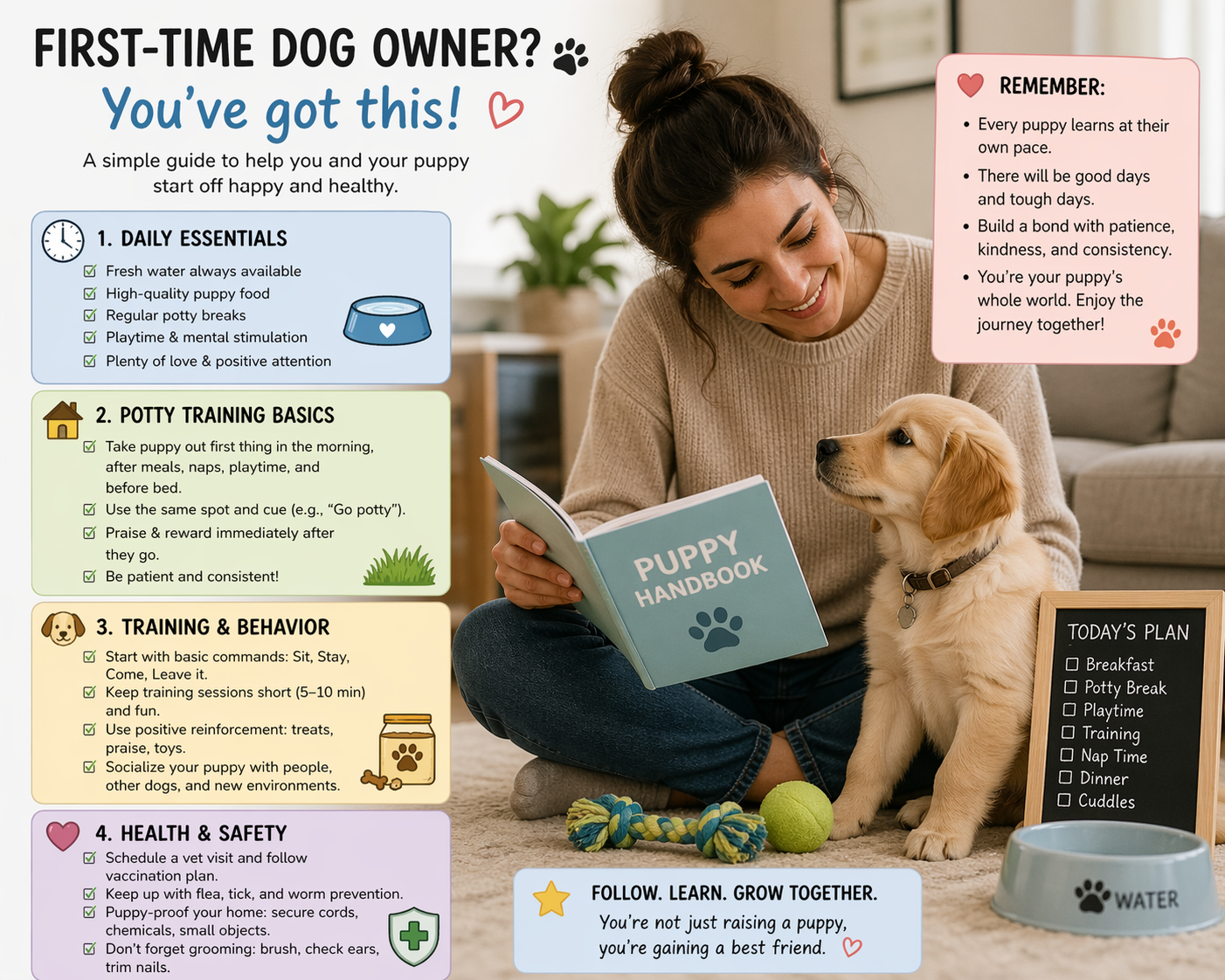
| ⚡ Quick Answer: Puppies need food, water, sleep, potty training, exercise, and a consistent routine. The first few weeks are the most important. Consistency matters more than perfection — and the tips in this guide will show you exactly what to do, day by day. |
Introduction
Bringing home a new puppy is one of the most exciting moments of your life — and also one of the most overwhelming.
Suddenly, you have a tiny creature depending on you for everything. And the questions start flooding in almost immediately.
How often should I feed my puppy? When should I start potty training? Why does my puppy cry at night? Can I leave them alone even for an hour?
If any of those questions sound familiar, you are in exactly the right place.
This step-by-step guide covers everything a first-time owner needs to know about how to take care of a puppy — from the first 48 hours to building routines, potty training, crate training, feeding, and sleep. Whether you have a newborn puppy or a two-month-old pup just arriving home, this guide walks you through every stage.
You don’t need to be perfect. You just need to be consistent. Let’s start from the beginning.
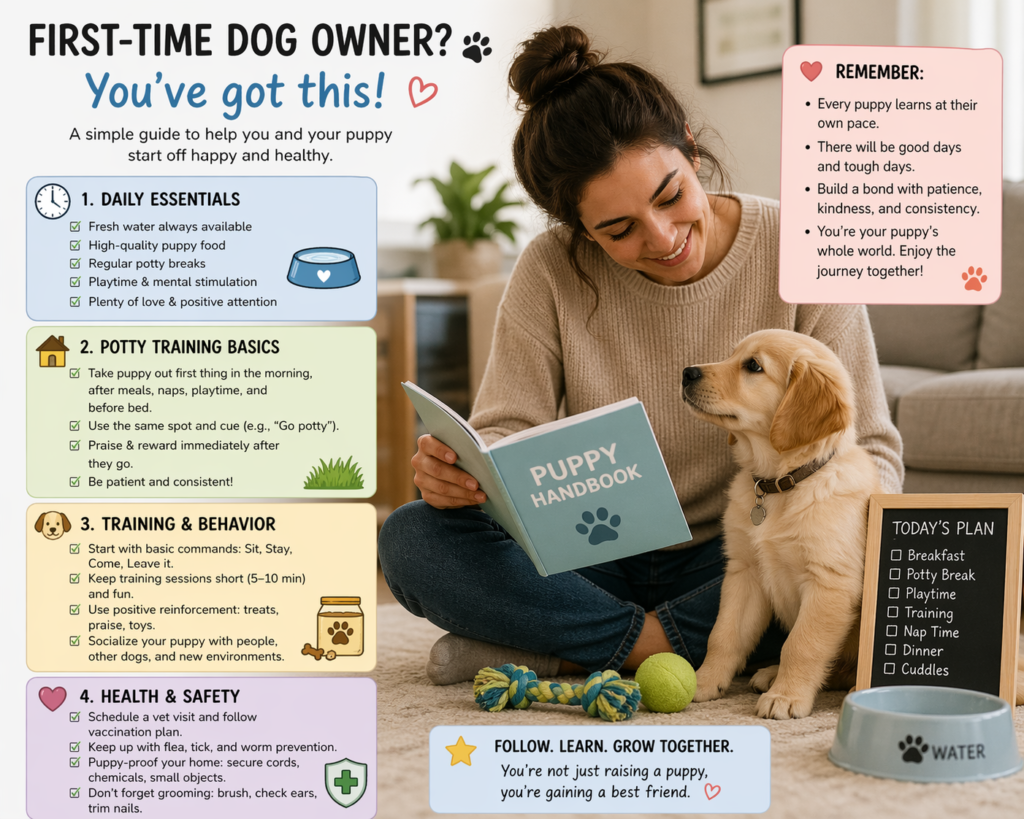
Who This Puppy Care Guide Is For
This guide is written specifically for:
- First-time dog owners who have never raised a puppy before
- Families with children bringing home their first pet
- Apartment owners wondering if puppy care in a small space is manageable
- Busy professionals who need a simple, time-efficient puppy routine
- Anyone caring for a newborn puppy, a 1-month-old puppy, or a 2-month-old puppy
- People looking for a puppy care guide week by week that actually tells them what to expect
If you just brought home your puppy — or you’re about to — keep reading. This guide is designed to feel like advice from a knowledgeable friend, not a lecture. I suggest you know about low maintained dog breeds.
Your First 48 Hours With a New Puppy
The first two days are the most emotionally intense — for you and your puppy. Here is what to expect and exactly what to prioritize.
What Your Puppy Needs Before Coming Home
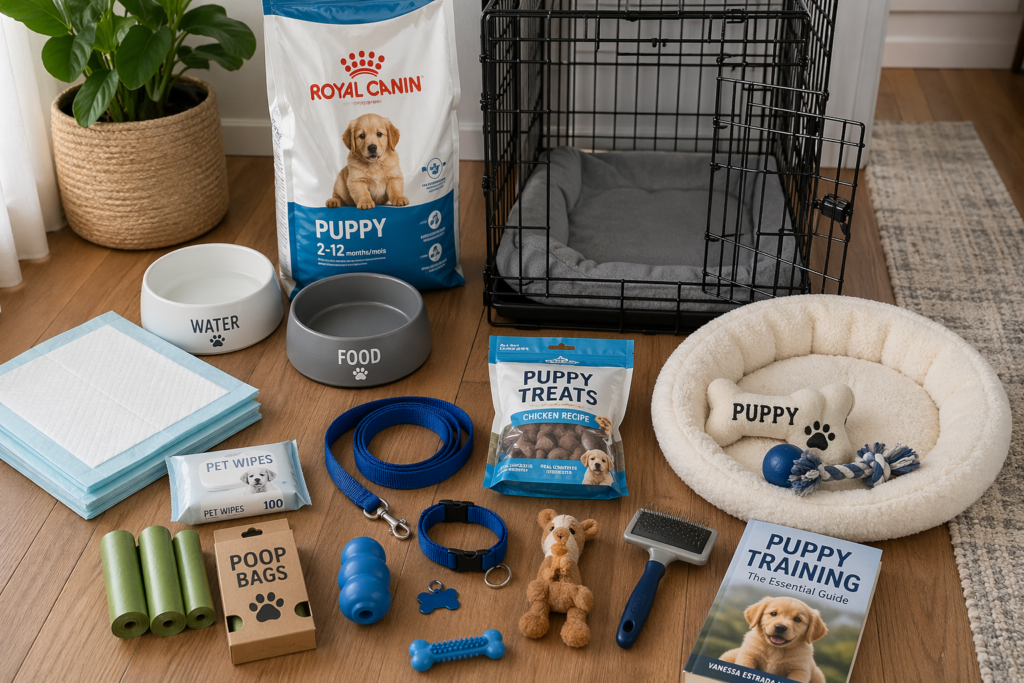
Before you even pick up your puppy, make sure you have these essentials ready:
| Category | What You Need |
| Feeding | Puppy food (vet-recommended), food bowl, water bowl |
| Sleeping | Crate, puppy-safe bed or crate mat, blanket |
| Potty | Pee pads, enzymatic cleaner for accidents |
| Comfort | Safe chew toys, soft plush toy |
| Safety | Collar, ID tag, leash |
| Grooming | Soft brush, puppy-safe nail trimmer |
What to Expect in the First 2 Days
Many first-time owners panic when their puppy acts strangely on day one. Here’s what is completely normal:
- Crying at night — Your puppy misses their mother and littermates.
- Refusing to eat — Stress and a new environment suppress appetite.
- Accidents in the house — They don’t know the rules yet.
- Following you everywhere — Puppies bond fast and seek security.
- Fear and nervousness — New smells, sounds, and people are overwhelming.
None of this means you are doing anything wrong. Give your puppy 48–72 hours to begin settling in.
First-Day Priorities
- Create a quiet, cozy space — limit access to just one room at first
- Offer fresh water and a small meal as soon as you arrive home
- Show your puppy the designated potty area immediately
- Start a simple, predictable routine from day one
- Keep visitors away for the first 1–2 days to avoid overwhelming your puppy
| 💡 Expert Tip: Place a worn t-shirt or blanket that smells like you in the crate. It provides comfort and reduces nighttime crying significantly. |
Building a Puppy Routine That Actually Works
If there is one thing experienced dog owners universally agree on, it’s this: puppies thrive on routine. A consistent schedule is one of the most powerful tools you have.
Why Puppies Thrive on Routine
- Reduces anxiety and stress in a new environment
- Makes potty training dramatically faster
- Establishes predictable feeding and sleep patterns
- Builds trust — your puppy learns what to expect from you
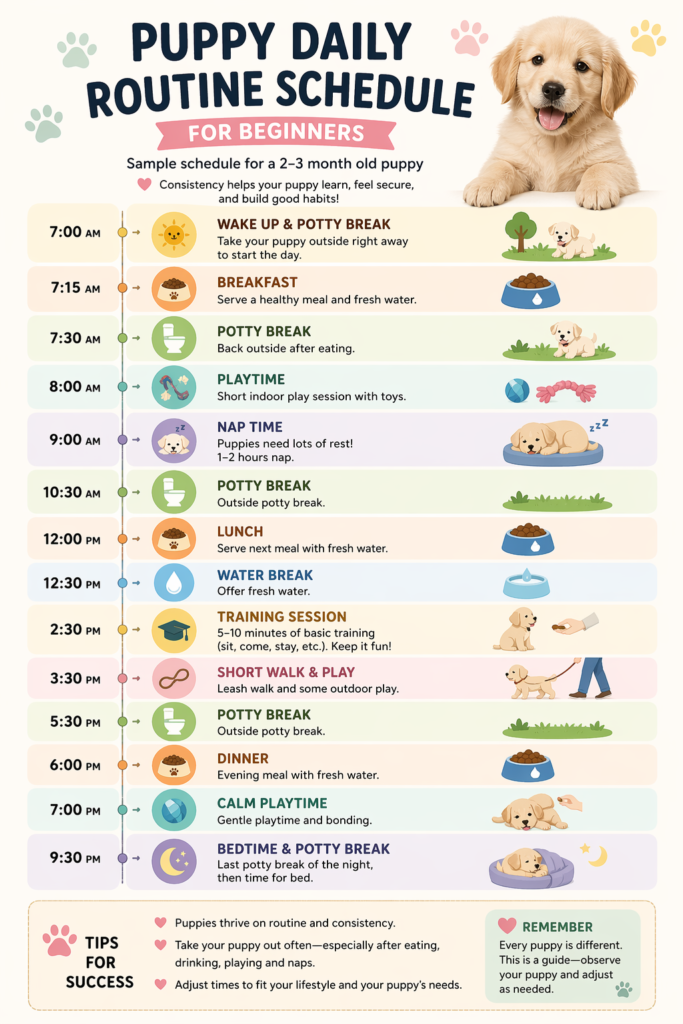
Sample Puppy Daily Schedule
Here is a realistic daily schedule that works for most puppies aged 8–16 weeks:
| Time | Activity |
| 7:00 AM | Potty break immediately upon waking |
| 7:30 AM | Breakfast (puppy food, measured portion) |
| 8:00 AM | Short play session or gentle walk |
| 9:00 AM | Nap time in crate |
| 11:00 AM | Potty break |
| 11:30 AM | Play and socialization |
| 12:00 PM | Lunch |
| 1:00 PM | Potty break, then nap |
| 3:00 PM | Potty break |
| 3:30 PM | Play, training session (5–10 minutes) |
| 6:00 PM | Dinner |
| 7:00 PM | Calm play and potty break |
| 8:00 PM | Quiet wind-down time |
| 10:00 PM | Final potty break before bed |
| 10:15 PM | Crate for sleep |
How Often Puppies Need Attention
| Need | Frequency (8–12 Weeks) | Notes |
| Food | 3x per day | Consistent times are critical |
| Potty break | Every 1–2 hours | After meals, naps, and play |
| Sleep/naps | Every 2 hours | 18–20 hours total per day |
| Exercise | 2–3 short sessions | 5 min per month of age |
| Training | 2–3 sessions daily | Keep each session under 10 min |
Puppy Care Guide Week by Week
Puppies develop rapidly. What your puppy needs at 2 weeks old is completely different from what they need at 4 months. Here is a breakdown of puppy care by age so you know exactly where you stand.
| Puppy Age | Main Needs | Potty Frequency | Sleep Hours |
| 0–2 Weeks | Warmth, mother’s milk or formula | N/A (mother handles it) | 20–22 hours |
| 3–4 Weeks | Soft food introduction, socialization | Mother’s area | 18–20 hours |
| 1 Month | Soft food, safe exploration, warmth | Every 2 hours | 18–20 hours |
| 2 Months | Potty training, crate training | Every 1–2 hours | 18–20 hours |
| 3–6 Months | Training, exercise, socialization | Every 3–4 hours | 16–18 hours |
Newborn Puppies (0–2 Weeks)
Newborn puppies are completely dependent. If you are raising newborns without the mother (orphaned litter), this stage requires around-the-clock care.
- Warmth is survival: Newborns can’t regulate their own body temperature. Keep them at 85–90°F for the first week.
- Feeding: Feed every 2 hours using the mother’s milk or a high-quality puppy milk replacer formula.
- Stimulation: Gently stimulate elimination after each feeding using a warm, damp cloth.
- Monitoring: Track weight daily. Healthy puppies gain weight steadily. A puppy that loses weight needs immediate veterinary attention.
- No training yet: Eyes and ears are not open until weeks 2–3.
3–4 Week Old Puppies
This is when puppies start to look like actual dogs. Eyes open, ears open, and they start wobble-walking.
- Begin introducing soft, wet puppy food mixed with water — known as puppy gruel
- Socialization begins: gentle human handling daily shapes future temperament
- Early potty habits form — puppies will start moving away from the sleeping area to eliminate
- Short supervised exploration periods outside the whelping area
1 Month Old Puppy Care
At one month, puppies are curious, playful, and growing fast. This is a transitional period before the major milestones at 8 weeks.
- Feeding: 3–4 small meals per day of soft or moistened puppy food
- Sleep: 18–20 hours per day — most of life is still sleeping
- Toys: Introduce soft, safe toys for gentle exploration (no small parts)
- Socialization: Gentle exposure to different sounds, textures, and people
- No vaccinations or hard training yet — this stage is about comfort and growth
2 Month Old Puppy Care
Two months (8 weeks) is when most puppies come home — and when the real work begins. This is the most critical window for training and bonding.
- Vaccinations: First round of core vaccines typically happens at 8 weeks. Schedule your first vet visit immediately.
- Potty training: Start from day one. Use the consistent schedule outlined above.
- Crate training: Begin positive crate associations right away.
- Teething: Expect chewing. Redirect to appropriate toys, not punishment.
- Basic commands: Start with sit, come, and their name. Keep sessions 5–10 minutes.
3–6 Month Old Puppy Care
Puppies at this age have more energy, longer attention spans, and stronger chewing behavior. This is the prime window for obedience and socialization.
- Longer walks (increase gradually — 5 minutes per month of age as a rule of thumb)
- More complex training: stay, leave it, down, recall
- Stronger chewing — frozen treats, rubber chew toys, and Kongs become essential
- Puppy classes or structured socialization with other vaccinated dogs
- Routine becomes more predictable — potty breaks can stretch to every 3–4 hours
How to Potty Train a Puppy Faster
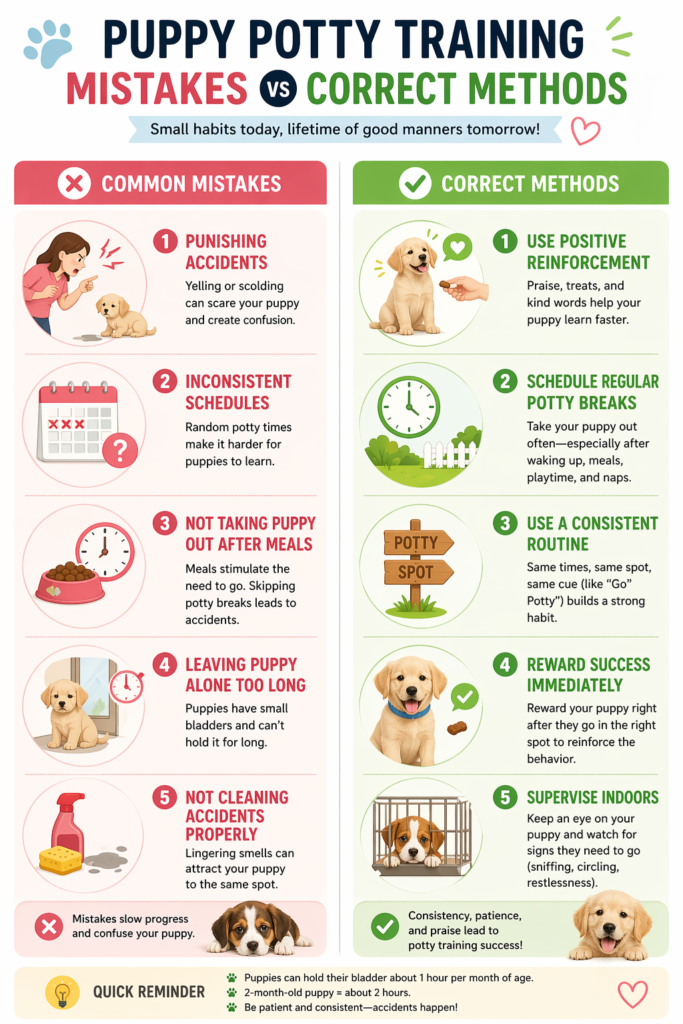
Potty training is the number one concern for almost every new puppy owner. The good news: it is not complicated. It just requires consistency.
Why Most Potty Training Fails
Most potty training problems come down to a few common errors:
- Inconsistent schedule: Taking the puppy out randomly instead of on a fixed timetable
- Punishing accidents: This creates fear, not understanding. Puppies can’t connect punishment to something they did minutes ago
- Waiting too long: Young puppies simply cannot hold it more than 1–2 hours
- Not recognizing signals: Missing the pre-potty warning signs means the accident happens before you can intervene
Step-by-Step Puppy Potty Training Framework
6. Take your puppy outside every 1–2 hours, and always immediately after meals, naps, and play
7. Use the same potty spot each time — the familiar scent helps trigger the behavior
8. Reward immediately with a treat and enthusiastic praise — within 3 seconds of the act
9. Learn your puppy’s pre-potty signals (see below) and act quickly when you see them
10. Keep feeding times consistent — predictable meals lead to predictable potty needs
11. Use the crate correctly — puppies naturally avoid soiling their sleeping space
12. Track accidents by location and time to identify patterns
Signs Your Puppy Needs to Go Outside
Watch for these signals. They are your puppy’s way of communicating before it’s too late:
- Sniffing the floor intensely — often in circles
- Circling a spot
- Whining or pacing
- Going toward the door
- Sudden restlessness after being calm
- Squatting — act immediately
How Long Does It Take to Potty Train a Puppy?
| Puppy Age | Typical Potty Training Timeline | Notes |
| 8–10 Weeks | 4–8 weeks to see real progress | Accidents daily — completely normal |
| 3 Months | 2–4 weeks additional progress | Holding it longer, fewer accidents |
| 4–6 Months | Near reliable | Occasional accidents still possible |
| 6+ Months | Fully reliable for most dogs | Some small breeds take longer |
Nighttime potty training takes longer. Expect midnight or early-morning trips until your puppy is 3–4 months old and can hold it for 4–6 hours.
Crate Training Without Making Your Puppy Hate It
Crate training is one of the most misunderstood parts of puppy ownership. Done right, your puppy will choose to sleep there voluntarily. Done wrong, it becomes a source of stress.
Why Crate Training Helps
- Speeds up potty training — puppies resist soiling their sleeping area
- Provides a safe, den-like space your puppy can retreat to
- Prevents destructive chewing and accidents when you cannot supervise
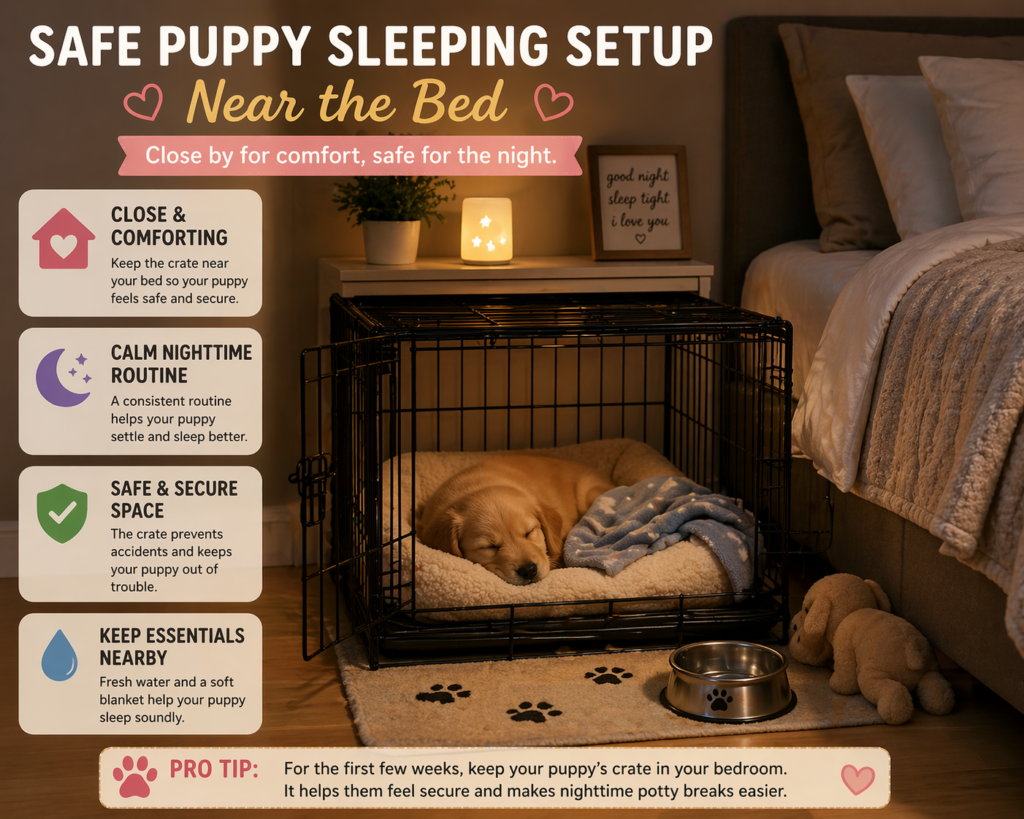
- Makes nighttime easier — a crate near your bed helps reduce crying
Common Crate Training Mistakes
| Common Mistake | What to Do Instead |
| Using the crate as punishment | Always keep the crate associated with positive experiences |
| Leaving the puppy too long | 8-week puppies can only manage 1–2 hours at a stretch during the day |
| Crate too large | A space just big enough to stand, turn, and lie down works best |
| Ignoring all whining | Check for genuine needs (potty, hunger) before ignoring |
| Rushing the process | Introduce the crate gradually over several days |
Beginner Crate Training Tips
13. Place the crate in your bedroom or a common area — never an isolated room
14. Feed meals inside the crate with the door open to build positive associations
15. Toss treats and toys inside throughout the day so your puppy enters willingly
16. Start closing the door for 1–2 minutes, then 5, then 10 — gradually increase
17. Add a worn t-shirt and a ticking clock to mimic the mother’s heartbeat
What to Do at Night With a New Puppy
The first few nights are hard. Most new owners don’t sleep well. Here is how to make it manageable — for both of you.
How to Take Care of a Puppy at Night
- Establish a bedtime routine: calm play, then a potty break, then crate
- Remove water 1–2 hours before bedtime to reduce nighttime bathroom needs
- Always do a final potty break right before you put your puppy in the crate
- Keep the crate near your bed — proximity reduces anxiety
- Use white noise or a calming sleep playlist to muffle startling sounds
- Keep the room temperature comfortable — not too hot, not too cold
Can You Leave a 2-Month-Old Puppy Alone at Night?
This is one of the most common questions new owners ask — and the honest answer is: only for short stretches.
A 2-month-old puppy can physically hold their bladder for roughly 3 hours overnight at best. Most will need at least one midnight potty trip in the first few weeks.
Leaving a 2-month-old completely alone overnight (in a separate room, far from you) often leads to prolonged crying, anxiety, and slower progress with crate training. Keep them close, at least for the first few weeks.
Why Puppies Cry at Night
| Reason for Crying | What to Do |
| Needs to go to the bathroom | Take outside immediately, no play — straight back to crate |
| Hungry (if underfed) | Review feeding schedule with your vet |
| Fear of being alone | Move crate closer to you; use calming aids |
| Missing their littermates | Warm water bottle wrapped in a blanket can help |
| Overtired and overstimulated | Earlier bedtime, less activity before bed |
Feeding, Water, and Sleep Basics
Getting the basics right on food and sleep prevents a huge number of health and behavior problems down the road.
How Often Should Puppies Eat?
| Age | Meals Per Day | Food Type | Notes |
| 0–4 Weeks | Every 2 hours | Mother’s milk or formula | Critical for survival |
| 4–6 Weeks | 4–5x per day | Soft/wet puppy food (gruel) | Transition from milk |
| 6–12 Weeks | 3–4x per day | Puppy kibble or wet food | Measured portions |
| 3–6 Months | 3x per day | Puppy food by breed size | Follow bag guidelines |
| 6–12 Months | 2x per day | Puppy or adult food | Vet guidance needed |
Dry vs wet food: Both can work well. Many owners mix wet food with kibble for palatability. Whatever you choose, stick with the same brand initially to avoid digestive upset.
Safe treats: Small, soft treats for training. Keep treats to less than 10% of daily calories.
Water: Fresh water should be available at all times during the day, removed 1–2 hours before bed.
How Much Sleep Do Puppies Need?
Most first-time owners are surprised by just how much puppies sleep. This is completely normal and necessary for healthy development.
- 0–4 months: 18–20 hours per day
- 4–6 months: 16–18 hours per day
- 6–12 months: 14–16 hours per day
An overtired puppy becomes a cranky, bitey, and anxious puppy. Watch for signs of tiredness: yawning, losing interest in play, stumbling, or getting nippy.
Sleeping Puppy Habits That Are Completely Normal
- Twitching and paddling legs during sleep — this is normal REM sleep
- Whimpering or making sounds during dreams
- Sleeping in odd or contorted positions
- Sudden waking for no apparent reason
Beginner Puppy Training Beyond Potty Training
Potty training gets all the attention — but early obedience training is equally important. The good news: puppies at 8 weeks old are capable of learning basic commands.
The First Commands Every Puppy Should Learn
| Command | Why It Matters | How to Start |
| Sit | Foundation of all training | Lure with treat above nose, reward when bottom touches floor |
| Come | Safety and recall | Say name + ‘come’ in a happy voice, reward every time they arrive |
| Stay | Impulse control | Ask for sit, say stay, take one step back, reward — build distance slowly |
| Leave it | Prevents dangerous chewing | Place treat on floor, cover with hand, reward when they look away |
| Down | Calm and settle behavior | Lure treat from nose to floor in an L-shape, reward when they lie down |
Best Puppy Training Tips for Beginners
- Keep sessions short: 5–10 minutes maximum for young puppies
- Always end on a success — even if it means making the last task easy
- Reward immediately — the treat must come within 2–3 seconds of the behavior
- Use a consistent marker word like ‘yes’ or a clicker
- Never yell or use physical correction — it damages trust
- Train before meals when your puppy is motivated by food
Beginner vs Advanced Puppy Training
| Beginner Focus (0–4 Months) | Advanced Focus (4+ Months) |
| Potty training | Off-leash recall under distraction |
| Sit and stay | Advanced obedience commands |
| Crate training | Agility or trick training |
| Name recognition | Canine Good Citizen certification |
| Socialization | Complex problem-solving enrichment |
Common Puppy Care Mistakes New Owners Make
Even well-intentioned owners make mistakes. Here are the most common ones — and how to avoid them.
| Common Mistake | Why It Causes Problems | What to Do Instead |
| Too many visitors in the first week | Overwhelms the puppy, increases stress | Limit guests for first 5–7 days |
| Too much freedom too early | Leads to accidents and destructive behavior | Confine to one room, expand gradually |
| Punishing accidents | Creates fear, not learning | Clean up calmly, adjust the schedule |
| Overfeeding treats | Upsets diet, reduces meal motivation | Keep treats under 10% of daily intake |
| Inconsistent rules | Confuses the puppy about expectations | Everyone in the household follows the same rules |
| Skipping socialization | Creates fearful, reactive adult dogs | Expose to sights, sounds, people, and animals early |
| Leaving puppy alone too long | Separation anxiety and accidents | Build alone time gradually over weeks |
| ✅ What Actually Works: Structure + patience + positive reinforcement + predictable routine. These four elements solve 90% of early puppy problems. |
Puppy Care Checklist for Beginners
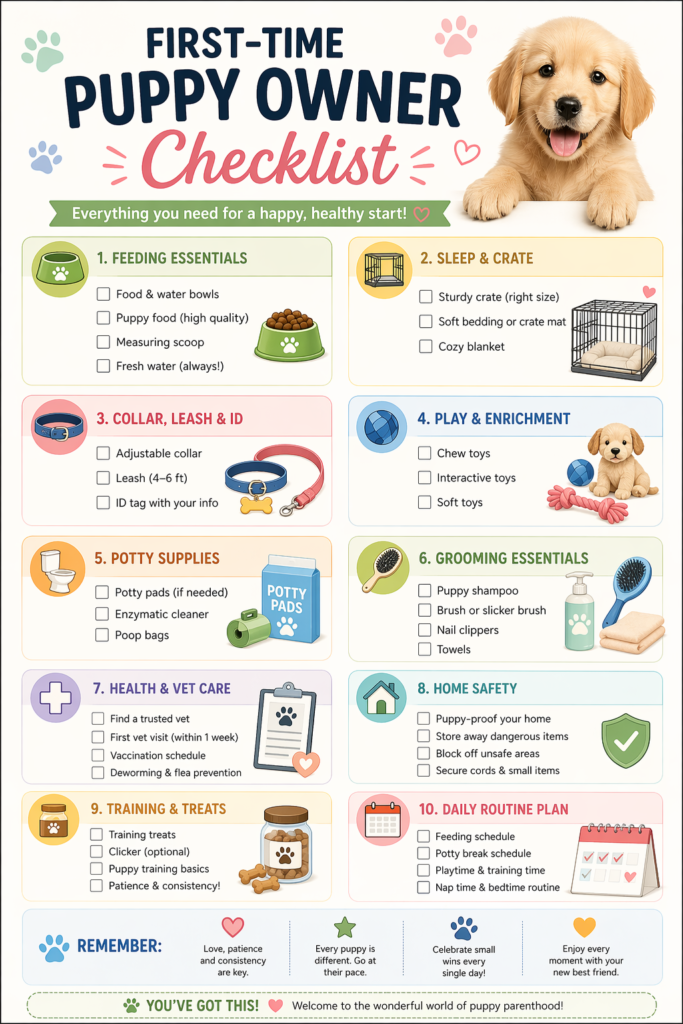
Essential Puppy Supplies Checklist
- Food and water bowls (stainless steel or ceramic)
- Age-appropriate puppy food
- Appropriately-sized crate
- Puppy-safe bed or crate mat
- Safe chew toys and enrichment toys
- Pee pads (for indoor training or emergencies)
- Leash, collar, and ID tag
- Enzymatic cleaner for accident cleanup
- Soft brush for grooming
- Nail trimmer
First Vet Visit Checklist
- Core vaccinations (schedule depends on age and prior vaccines)
- Deworming treatment
- Microchipping
- Flea and tick prevention
- Food and portion size recommendations
- Weight check and growth assessment
- Spay/neuter discussion timeline
What Actually Works in 2026 for Raising a Puppy
Puppy care has evolved. There are now tools and approaches that make the process significantly easier — especially for busy owners.
Modern Puppy Care Trends That Genuinely Help
- Positive reinforcement training: Science-backed and universally recommended. Reward what you want, redirect what you don’t.
- Slow-feeding bowls: Reduces gulping and bloat risk, especially in larger breeds.
- Smart pet cameras: Monitor your puppy while you’re at work. Some include two-way audio and treat dispensers.
- Puppy schedule apps: Apps like Dogo or Puppr help you track potty breaks, meals, and training sessions.
- GPS collars: Useful for escape-prone puppies or larger properties.
- Enrichment toys: Puzzle feeders, Kongs, and snuffle mats provide mental stimulation beyond physical exercise.
- Frozen teething treats: Freeze puppy-safe broth in ice cube trays. Provides relief during teething without the chewing destruction.
Best Tools for Busy Puppy Owners
| Tool | What It Does | Why It Helps |
| Automatic water fountain | Keeps water fresh and flowing | Encourages hydration |
| Indoor puppy pen | Creates a safe, expandable zone | Limits accidents and destruction |
| Treat pouch | Hands-free treat access during training | Faster rewards = better training |
| Puppy camera | Monitor from your phone | Peace of mind at work |
| White noise machine | Masks startling sounds | Better sleep for everyone |
| Kong toy | Stuffable with food, freeze overnight | Keeps puppy busy for 20–30 min |
Common Puppy Problems and Solutions
| Problem | Most Likely Cause | Solution |
| Crying at night | Fear, bathroom need, or loneliness | Potty break + comfort (crate near bed) |
| Chewing furniture | Teething and boredom | Redirect to safe chew toys immediately |
| Potty accidents | Inconsistent schedule | Increase potty frequency, use crate |
| Biting hands | Teething and play behavior | Say ‘ouch’, redirect to toy, stop play briefly |
| Refusing to eat | Stress or wrong food | Try warming food, reduce stress, consult vet |
| Barking excessively | Boredom, fear, or attention-seeking | More exercise, training, and enrichment |
Frequently Asked Questions
Here are honest answers to the most commonly searched questions about puppy care.
1. How to take care of a puppy for beginners?
Start with the basics: consistent feeding times, a regular potty schedule, crate training, and lots of patience. Focus on one area at a time. Potty training and a daily routine are your two highest priorities in the first few weeks. Don’t try to teach everything at once.
2. How to take care of a puppy at home?
Puppy-proof your space before bringing your dog home. Block off rooms where you can’t supervise, secure electrical cords, and remove anything chewable at puppy level. Set up a designated sleeping, eating, and potty spot. Puppies do best in a small, manageable space at first — expand their freedom as they earn it through good behavior.
3. How to take care of a 2-month-old puppy?
A 2-month-old puppy needs three meals per day, potty breaks every 1–2 hours, 18–20 hours of sleep, gentle socialization, and the beginning of crate training. This is also the age for their first veterinary visit and vaccines. Keep training sessions short — 5 minutes maximum — and focus on name recognition, sit, and come.
4. How to take care of a puppy at night?
Create a calming bedtime routine: wind down play, offer a final potty break, then settle into the crate. Keep the crate in your bedroom for the first few weeks. Expect at least one middle-of-the-night potty trip for puppies under 12 weeks. Use white noise to reduce startling sounds. Do not let your puppy cry it out for extended periods in the early days — check for genuine needs first.
5. Can I leave my 2-month-old puppy alone at night?
Not fully. A 2-month-old puppy cannot hold their bladder for more than 2–3 hours overnight. They also need emotional comfort in a new environment. It’s best to keep your puppy’s crate in your room for the first 1–4 weeks, then gradually transition them to sleeping further away if that’s your preference. Leaving them completely isolated overnight too early increases anxiety and slows training.
6. How long does it take to potty train a puppy?
Most puppies show real, reliable improvement within 4–8 weeks of consistent training. Complete reliability — where accidents are rare — usually comes at 4–6 months. Smaller breeds often take longer due to smaller bladder capacity. Consistency is the single biggest factor: the more regular your schedule, the faster your puppy learns.
7. What is the 7-7-7 rule for puppies?
The 7-7-7 rule is a socialization guideline: by 7 weeks, puppies should experience 7 new environments and meet 7 new people. Some trainers extend this to 7 surfaces, 7 sounds, and 7 different types of animals. The goal is early, positive exposure to a wide variety of stimuli so your puppy grows into a confident, well-adjusted adult dog.
8. How often should a puppy eat?
Feed puppies aged 6–12 weeks three to four meals per day. From 3–6 months, three meals per day. From 6–12 months, transition to two meals per day. Always follow the feeding guidelines on your specific puppy food packaging as a starting point, then adjust based on your puppy’s weight and vet recommendations.
9. How much sleep do puppies need?
A lot more than you might expect. Young puppies sleep 18–20 hours per day. This is not laziness — it is essential for brain development, growth, and immune function. Protect your puppy’s nap times. An overtired puppy behaves like an overtired toddler: cranky, nippy, and difficult to manage.
10. What should I do during the first 48 hours with a new puppy?
Keep things calm and simple. Set up a quiet, cozy space. Introduce water and food. Take your puppy to the potty area right away. Start your routine immediately. Limit visitors and overwhelming stimulation. Focus on bonding, safety, and establishing trust rather than training in those first two days.
11. How do you potty train a puppy fast?
The fastest method is a consistent schedule combined with positive reinforcement. Take your puppy out every hour, after every meal, after every nap, and after every play session. Reward immediately and enthusiastically. Never punish accidents — just clean them up with an enzymatic cleaner and adjust your schedule. A puppy who is praised lavishly for going outside will seek to repeat that experience.
12. What should I buy before bringing a puppy home?
At minimum: crate, bed, food and water bowls, age-appropriate puppy food, pee pads, enzymatic cleaner, collar, ID tag, leash, and a few safe toys. Optional but helpful: a treat pouch for training, a puppy pen to create a safe zone, and a white noise machine for nighttime.
Your Final Action Plan: What to Do This Week
You don’t need to be perfect — you need to be consistent. Here is your first-week action roadmap:
18. Day 1–2: Focus on comfort and safety. Introduce water, food, and the potty spot. Start a simple routine.
19. Day 3–5: Begin crate training with short, positive sessions. Maintain your potty schedule without exceptions.
20. Day 6–7: Introduce a 5-minute training session for sit and name recognition. Keep it light and positive.
21. Week 2: Book your first vet visit if not already done. Continue building routine and positive crate associations.
22. Week 3–4: Expand training to come and stay. Begin very gentle socialization — short, positive encounters.
23. Month 2: Enroll in a puppy class if available. Extend potty break intervals as your puppy demonstrates reliability.
Remember: every puppy is different. Some will have this figured out in weeks. Others will take months. The journey is worth it.
| 🐾 You’ve got this. Thousands of first-time owners have successfully raised happy, well-trained dogs — and so will you. Stay consistent, stay patient, and celebrate every small win. |